A look at how we can develop confidence in our lives and sports by considering sea-kayaking and equestrian sport
Setting the scene – our environment
It was a beautiful day and the promise of a trip along fabulously folded coastal cliffs with possible sightings of seals and a variety of seabirds was enticing.
Ceibwr Bay
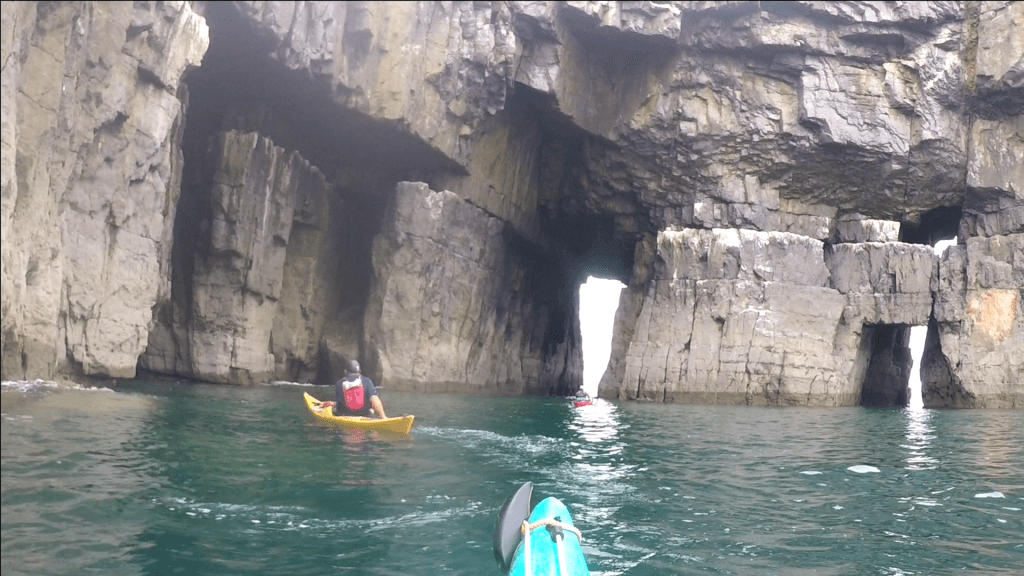
We knew that it had been breezy and that we could expect onshore (westerly) winds (around 10-13 mph) for a paddle out of Ceibwr bay. It was no surprise then to have some rolling swell even in the bay on an incoming tide. What we found was rather more than that. As we neared the end of the bay I could see a line of bigger water: larger swell with some white tops. Not so long ago, I wouldn’t even have got this far; not so long ago I would have been afraid to make a turn on these waves; not so long ago my butterflies would have been more than fluttering, they would have been dialling my fear needle to ten. Nonetheless, the swell was choppy and I wasn’t prepared to go any further. It is one thing to pass through a short patch of difficult water, but this would have been relentless and I didn’t feel ready, or safe, to continue.
We turned back.
So, these waves were, on the plus side, not too muddled, they were pretty much rolling inshore in regular sets and weren’t breaking. The downside was that they had tops disturbed by wind and were about a metre and a half of swell. Not only was I disappearing into troughs but it was very much a case of ‘now you see me, now you don’t’ when trying to spot Christopher in his yellow boat. When I looked at stills from the video, it was also possible to see just how much the boat was rocking and tipping, so (once again) I was blessing the primary stability of the Scorpio which is never in a hurry to tip me out.
We headed back towards the shore and my nerves calmed, my muscles settled, the butterflies ceased the manic flights. Reflecting, I realised that although it was still all a bit much for me today, the fear needle only reached about eight.
Do we have a sixth sense?
If you’ve read any of my other blogs or if you know me, you might well realise that the sea is not my immediately comfortable home: put me around horses and I know what I’m doing. I’ve been doing it for pretty much all of my life and have managed to develop what I think is probably a sixth sense. So I’d like to talk about that sixth sense that we have around different environments and how that works for different people.
How often have you heard someone say jokingly, that we, as human beings have a sixth sense? It’s not really telepathy, but certainly if we’re talking about horses, we understand FEEL, and that’s not just by sitting on the horse, it’s about being around a horse. One of the things that has always interested me is how much people who are new to being around horses tend to get trodden on, nipped, barged over, or fall off. The reason for these mishaps is generally not because the horse is unpleasant or unkind, nor because the person is unpleasant or unkind: they haven’t yet developed that sixth sense. In practical terms it is just a little more than a flick of the horse’s ear, the look in it’s eye, the way it moves, the tension in it’s muscles, it’s reaction to the current environment. So in that context, we’re talking ‘horse sense’ and this is something that definitely changes the more you’re around horses. I could talk for ages on that, but today’s blog is about paddling, so holding onto this idea of a ‘learned sixth sense’, lets start relating this to kayaking so we can illustrate ‘feel’ in a different context.
My husband, Christopher, has been on the sea and around the sea, pretty much all his life in the same way that I have been around horses. He has that sixth sense around the sea. He understands it, he can see what’s happening. He interprets what’s going on very quickly. And he doesn’t get frightened by things which might unnerve others who – like me – are less used to the sea. It’s this same mystical sixth sense about what’s happening around us. The information that we are taking in is more than just visual, it is often defined by all our senses at once to create the complete picture.
When we relate this to learning or coaching we consider how we process the information around us (perception) and then couple this to the actions that we need to take in that situation. It’s a very personal thing and in coaching we need to allow individuals to discover their own solutions: it’s no good if I expect to manage my kayak over a particular wave in the same way that someone in a different kayak and of different build will manage theirs over that same wave.
This perception-action coupling is very possibly the modern idea of the ‘sixth sense’ or ‘feel’. Effective, coupled perception of our context, and action to manage it will ultimately make us safe and effective in our movements – and hence in our sport.
Relating ‘feel’ and confidence through experience
In both these sports (equestrian and paddling) we are having to move our bodies to balance and effect the movement that we need – a brace to stop the boat going over or a shift of our weight over the horse’s centre of balance to allow the horse to find it’s own way of moving. In order to be effective like this we need to be attuned to our environment and to be relaxed enough to move easily. (We can ‘self-organise’ and put ourselves in a useful position).
Ah.
With confidence comes a moment of calm which allows us to find the split moment in time to initiate the right movement or reaction. It’s also easier to move effectively if we are relaxed mentally and physically.
This is where reflection comes in. Whilst we need to do things ‘in the moment’ it is incredibly important to reflect on our experiences so that we can draw (personal) meaning from them and then pick out elements that will help us in future.
Taking up kayaking has reminded me of the feeling of ‘fear’ when faced with doing something. I think about the steps I take to improve my confidence on the water and then relate these to the equestrian environment. I’d like to think that I use this effectively as an empathetic approach towards helping people on their horses.
Classically, somebody will come to me and say they are afraid to go jumping. I need to understand that fear and I certainly do understand that fear. I’ve been there, I’ve fallen off , I’ve suffered with butterflies and nerves.
In the same way that I’ve now got used to that, I’m beginning to get used to kayaking on slightly bigger water, different waves and in different environments. I don’t think my sixth sense is developed yet, but I’m certainly, perceiving things differently. I’m able to feel things more easily. I’m be able to look at waves and be rational about what is likely to happen. Is it a bit lumpy? Is it a swell coming towards me? Will my boat just ride over that, or am I going to get tipped in? Is that a Whirlpool? Is that swirling water? Is that fast running water? What’s it going to do to the boat?
And now, instead of having all the terrifying worst case scenarios run through my mind, I can actually think, ‘No, I have been there. I’ve been through that. And I’ve survived it. And this is what I did’.
Rules for developing confidence
We all know that someone can tell you to ‘relax!’ until they’re blue in the face and the more they do that, the less you will relax. If we add in a constraint of some kind, (close your eyes, chat and be distracted, focus on a different issue/challenge or element) and you will find that you relax (into doing what you need to do) without even realising it. Look at the cormorants and you’ll stop focusing on where the next wave is coming from. You can look at the scenery, you can look at things around you, and you suddenly think, ‘Oh, I’ve got from A to B. And I didn’t worry about it. And it was fine. And I did the right paddle strokes’. It’s the same with riding, often I have my nervous jumpers singing or watching me instead of the jump. Their first thought, typically, is that I’m mad, but it works.
So that’s the first thing the second thing is experience. Again, someone can tell you that this particular sort of wave is not going to tip you in if you do this, that or the other. If we are nervous, we need to prove it to ourselves; only then will we embed it in our own experience log. Remember to learn as you go, start to create the link between the environment and what it is that you do to achieve your result. When you reflect you can use that again in a benchmark for future trips.
Third, compare your experiences and create a measure for how far you have come. Don’t be pushed. If there is one thing that we need to know about confidence it is that (for most people) it as fragile as fine glass. With my jumpers, I always create a ‘safety zone’ – it’s a jump or jumps that they can always complete so that if things go pear-shaped (they will at some point because that is part of learning!), they will have a good start-point to help rebuild when we need to. I recently created an argument for never leaving your comfort zone – that’s another story – but the advantages of staying within it are that you can fine-tune skill, you can relax and enjoy what you do and you can become expert in small (but important) things. My message here is don’t cross the comfort line too far or too soon. One day you will decide for yourself that you want the next challenge and you will step out of that comfort zone happily and comfortably. It’s the same with horses. It’s the same with jumping. It’s the same with paddle sports. (Oh, and it’s the same in organisations too!).
Reflecting on y our own experience is crucial. It doesn’t have to be written or spoken aloud, just thinking through what has happened and what you’ve done. You might ask yourself questions:
‘Did I do the best thing there?’
‘Could I change my technique for a better outcome? ‘
‘Was the result what I wanted? ‘Did it need to be better or different?’
‘Realistically am I able to change what I did?’ ‘ Do I need new skills?’
…and so on….
And in summary…..
You can build your own experience, you reflect on it and that’s effectively what I’m doing through my blogs and my videos. It’s not so much to share it for the world to see because there’s nothing dramatic here, but in taking on a new sport I have gained an opportunity to re-visit ‘nerves’ and that, I hope, will benefit not only me but also my equestrian clients.
I will always be delighted if somebody else who has the same kind of confidence issues that I have can read this and realise that they aren’t alone. I’m not afraid to say ‘I can’t do that, (yet)’. I’m not afraid to say ‘I don’t want to go there (today)’.
So if you’ve got any questions about building confidence, if you’ve got any questions about how to say no, if you’ve got any questions about whether you’re feeling you’re wimping out, just give me a call, drop me a line, send me an email, and we’ll sort out how to build confidence. (It’s true in any sport, but also in my executive coaching world). It’s little by little and it’s through self reflection, and positive support from the people around you.
Tips and thoughts on sea-kayaking the Great Glen canoe trail. An honest account of what we got right as well as what we could have done better
May 2021
Part two: getting onto the water
Banavie – almost packed
This is the second part of my blog about paddling the Great Glen. The scenery was superb, the weather not great, but the experiences were memorable. Would I do it again? Probably not, but only because there are so many other places to go!
We paddled medium volume Scorpios which were great boats – stable and with a good deal of room for kit. We even had camp chairs…..
If you are planning to do the trip, I hope that you’ll find some useful tips here as well as photos which show a few things that you might look out for. (And I don’t only mean where the pontoons are located!).
The plastic boats were great, as hauling them out onto the pontoons was no small feat as they were quite heavily laden. Still, by the time we’d done a few portages we got quicker and found it easier. There were a good few times that I was glad we didn’t have composite boats! The portages sounded quite tough, but the only ones which really caused us trouble were at Gairlochy (where there were major building works) and at Laggan locks where the signage is unhelpful and lead us to traipse past the cottages.
If you do the trip and enjoy it as much as we did, then you’ll have had a fabulous time.
1. Getting going, the logistics: Parking, loading launching
Top tips 1
We planned to paddle from South-West (Banavie, near Fort William) to North-East (Muirtown, Inverness) and as it was just the two of us with one vehicle we needed to get the logistics right and keep the boats safe. Here are a few things that are worth knowing if you are planning to do the Great Glen Canoe trail -GGCT. (Have a look at part one of the blog to see more about which direction works best and why).
We had booked two weeks holiday so that we had a chance to chose the best days weather-wise. As it turned out we didn’t need to use extra time, but with the vagaries of the weather it would always be wise to allow additional days so that if necessary you can sit out for a day and stay safe.
The start of the trip is about 2 miles from Fort William
Notes on facilities
Parking at the start: There is a huge car park at Banavie, but it is easier to drive behind the hotel and turn between the houses onto the quay to unload. There is a boat rack near the showers where you can leave the boats. We had a padlock on a long leash which went behind the seats and round both boats.
Provisions and transport: About two miles away there is a big supermarket right next to the bus and rail station. From there it is a short walk into Fort William if you fancy a trip to Nevis Sport (great cafe!) or to pick up something you’ve just realised that you forgot to bring from home!
Left Luggage: There are large left luggage lockers at the station so we left as much as we could there to save carrying kit back on the bus. Yes, there was room for our paddles (all splits). In hindsight we could have done without taking the rucksacks as they were a nuisance on the boats and took up quite a bit of space.
We left the boats on the racks and drove the van to Inverness where we stayed overnight then parked near the Muirtown locks.
Handy Taxi office and takeaway below the locks
It sounds obvious but don’t forget that the end of the paddling trip is above the Muirtown locks. We parked just below them, but it is possible to drive round to a cul de sac to retrieve kit at the end, and save a long portage down to the very bottom (when you might well be tired! We were…)
We took a taxi to the bus station and caught the Stagecoach Highland coach back to Fort William. Check details as they may not be frequent but it was a comfortable, picturesque journey of about 2 hours. Once back at Fort William station we walked over to the supermarket for provisions, collected the kit from left luggage and flagged down a large taxi to take us and all our kit to where we’d left the boats. If you are a minimalist traveller and a fit walker you could carry it all to the start but time seemed to be disappearing fast and it seemed like a slog to walk and carry lots of kit at the beginning of the holiday.
Packing and getting going: A word of advice on packing – practice before you head off! We had done some practice (always need more!) and ended up quite well sorted with not too much kit on the decks (just the C-Tug, camp chairs and some drinks and maps). Be sure have your brew kit handy so that each time you stop you don’t have to re-pack everything just for a cup of tea. Again, it sounds obvious but when you are squeezing kit into every last bit of space in the kayak it can be tempting to move things around.
Learning point number one: remember that it is sometimes easier to put the dry bags into the hatches empty, then filling them when they are in the hatch. We found that small bottles of beer are fine to wedge into odd places, (very handy!). We could have done with more, smaller bags. (Actually, the very best way is to have someone with you who is an expert packer! Thank you Christopher 😊)
I don’t think that packing is ever fun, but it was a lovely sunny afternoon and we met some real kayakers (!), three very friendly fellows who had started out at Cape Wrath and were completing the final leg of their circuit back there. They were taking in some sunshine and having a break after an epic trip so far which had included a day of almost 50 miles after avoiding Ardnamurchan and making a serious detour on lochs and rivers. ( It’s OK, The Great Glen is quite enough for me!) It sounded like a long trip with quite a bit of carrying. What a story that would make.
2. Day one of paddling: Banavie to Gairlochy
Just under 6 miles to start with…
Like most people, we started above Neptune’s staircase, feeling that a short paddle at Corpach and then a portage for 500m followed by a 650m portage past the 8 locks of the staircase was probably not going to give us the best start.
Top of Neptune’s Staircase
This part of the plan went pretty much as we’d hoped until we reached Gairlochy. It was a steady paddle in the sun and, at just 5.9 miles was a pleasant evening trip enjoying the peace and the scenery with occasional walkers and cyclists on the towpath. The gorse was stunning – great yellow splashes of colour – and the cuckoos were vocal. When I think back to the trip these are two memories that accompanied us for the entire trip.
‘The Book’ had not foreseen the enormous building works that would be at Gairlochy in 2021, so our portage was long and rather awkward. The exit pontoon was fine (on the North side) but we had to take the boats over the road and across the building site to find a tiny area of grass for the tent. One of our biggest barriers was the parked diggers, dumpers and trailers where the guys were working. Still, the C-Tug did its job brilliantly and we certainly felt we’d given it a good test over difficult terrain. By the time we got back for the 2nd boat the workmen had brought her up onto the road because they would have blocked us in. Yet another example of some of the lovely kindnesses and hospitality that we experienced on our trip. The upsides of Gairlochy stopover? Stunning views of a snow-capped Nevis range and right by the trail facilities, (hot showers, washrooms).
The ‘campsite’Stunning views to Ben Nevis
Leaving Gairlochy the next day was to prove the beginning of the real challenge…….
3. Day two of paddling: Gairlochy to Leiterfearn (Loch Oich and Loch Lochy)
14.6 miles paddling
Our first challenge was to find a launch point, since the building works and locked safety fences meant that we had ended up on the South side. As we manhandled the boats into the waters of the sheltered little marina of Gairlochy Upper the cheerful seadog who shouted ‘you’ll have the wind in your faces today then!’ simply reiterated what we were already expecting on leaving the short stretch of canal for the open waters of Loch Lochy. (Was it named by the same folk who came up with Boaty McBoatface?).
‘The Book’ has a beautiful picture of the little pepperpot lighthouse as you leave the canal, with 3 canoes basking in sunshine on blue water. My dream of that was not to be. With the weather still not doing as forecast we decided that the south shore might give us some lee from the wind but the crossing to it was bumpy to say the least. The waves were very short with the grown up ones coming in pairs with a few white tops at around 2ft and the babies in between just keeping us on our toes.
The lovely stable Scorpio and some of our sea practices in the past year meant that this wasn’t as frightening as I’d have found it a year (or even 6 months) ago, but the constant bounce, bump, splash with a continuous eye on what was coming made for a trip that was not just physically, but also mentally tiring. And this is where my learning point number two comes in. Would it be more sheltered on the other side? It might be, but crossing the loch is going to be much harder than staying on one side. Make a decision, stick to good heuristics and be certain to make a choice based on sound information. Here I must mention Nick Cunliffe whose Lockdown sessions rang in my ears. Now I think I know what he was talking about! Look him up: https://www.kayakessentials.co.uk.
‘The Book’ did mention the possibility of short dumping waves and I learned exactly what that meant in practice. Still, I’m all for learning, it’s just that sometimes it is physically hard work as well as mentally testing. Well, by then we were ready for a brew so we stopped at a handy beach on the North shore (not far from Glas D’hoire) where we were rewarded not only with some lovely sunshine but also a stunning view down the Loch. There is no doubt that we were travelling up a magnificent route with dramatic views. Being May, the trees showed the beautiful young, delicate greens of Spring and the mixed woodlands of deciduous trees, larches and firs made for beautiful scenery. Still with us were glorious patches of gorse and the cuckoo which seemed to be following us closely.
Short, dumping waves on Loch Lochy
Interesting point: Loch lochy has its very own mythical monster, (rather strangely called Lizzie), which is a river horse said to emerge from the lake and take on equine form to feed on the banks. Rather darker tales talk of this beastie turning over boats on the loch. Yes, I can see why…..
A little further on is where ‘The Book’ recommends lowering your sails (I wish!!) and following the green maker buoys round Kilfinnan point as it can be busy. Hmmm. Only just past Lockdown 3.0 and in weather more suitable for a March date, we weren’t distracted by any other craft.
Loch Oich was beautiful and offered quite a few possible rest places (though we didn’t stop). The mixed woodlands all along our trip in their new May clothes were like some dreamed up painting. The dense blue-greens of the fir and pine forests punctuated with the delicate yellow-green of the fresh larches and shimmering silver birch added texture and light to the superbly crafted view, whilst the bright yellow gorse framed the scene on the banks. It was this that kept me going here as the headwind had been relentless and the waves unforgiving. The tiredness was in my bones and it is only with hindsight and a few months later that I can say objectively that it was an amazing experience. My forward paddling has improved no end, my confidence upped, and as I look back, the beauty of the Glen and the overall achievement is made greater by knowing it wasn’t plain sailing.
The signage and book are a little ambiguous for the exit at Laggan locks. As you head to the marina, you’ll see the jetty/pontoons, turn left and go 300m past moored boats and you’ll easily see quite a wide beach for an easy landing (unless you have a composite boat, in which case you will get wet feet). Look to your right and you’ll see the path off the beach and behind the white cottage. There is a low level pontoon on the North side for leaving Laggan locks. Phew. Another brew to fortify ourselves for the next stretch to Leiterfearn.
And then it started raining. Hard. Even our tiredness and the rain couldn’t detract from the from the absolute beauty of this tree-lined piece of canal. It is truly gorgeous. The bright yellow of the gorse and then mixed trees lining both sides lent myriad hues of green to the view and somehow the rain seemed to add to the peace of the place.
Tranquility
From this tranquil scene we headed into Loch Oich. How could ‘The Book’ have known that Covid and weather would mean no traffic under Laggan swing bridge, no water sports on Loch Oich? No cafes, food stops or pubs? It was still quiet. We still had the place pretty much to ourselves. ‘The Book’ is spot on in one respect though – Loch Oich is beautiful.
Under Laggan swing bridge to beautiful Loch Oich
We passed the island on our right and looked across for the trailblazer rest – you can pick it out by the boarded up cottage set back from the shore. There are no facilities except for the composting toilets and if you want running water you’ll need to find the waterfall behind General Wade’s military road.
Interesting fact: This is the first of the military roads built in the 1720s as part of George 1st’s plan to ‘put down the rebels’ by creating a network of military roads in the Highlands. (Kind of picking up where the Romans left off).
Here we met our first fellow travellers – a group of canoeists travelling in the opposite direction (sage people set off by one of the local adventure companies) and two walkers heading for Fort William along the Great Glen Way.
It’s amazing what you can pack into a sea kayak!
The latter’s offer of a spot of Bowmore (which we exchanged for shelter under our tarp) lead to a great evening sharing stories and chatting about travel. Here we had another intrepid adventurer – planning on a sabbatical so he could walk the PCT. The what? The Pacific Crest Trail. All 2650 miles of it between Canada and Mexico via California, Washington and Oregon. I’m impressed again. But I’ll still settle for the GGCT in a headwind….
Learning point number three: Bowmore can usefully be carried in plastic and still taste good!
Yes, we had chairs, a line for drying our kit and welcome shelter from the rain. I can live on noodles and pasta, but luckily Christopher insists on things that will help keep us comfortable – chairs, dry clothes, proper food and raiding his outdoor kit meant we could cook and prepare ourselves well for Loch Ness.
So far our stop points were in line with our plans and it looked hopeful that we could finish on day 5 – Christopher’s birthday. As it turned out, Nessie had other ideas.
4. Day three of paddling: Leiterfearn (Loch Oich) to Foyers Fort Augustus
A disappointing 6.6 miles only!
We set out from Leiterfearn feeling well-rested and with the cuckoo still following us. We knew it was going to be a long day to Foyers (half way up Loch Ness) for our next camp. However, our well-laid plans to arrive in Inverness on Christopher’s birthday were about to be well and truly challenged.
Leaving Kytra lock
The good news is that Loch Oich marks the highest point of the trail so our next break was at Cullochy Upper where we had an easy portage down about 200m. It’s a pretty little place but Kytra was even lovelier and would make for a very inviting stop. In both places the low level pontoon is on the North side and the exit pontoons are easy to spot and to take advantage of. We didn’t linger though as we knew that it was a long trip to our next camp half way up Loch Ness at Foyers and we were facing a long portage around five locks at Fort Augustus.
We paddled easily to Fort Augustus, confident that the long portage would be manageable – after all it is downhill and we were getting the hang of it now.
As we approached the exit pontoon we met two paddleboarders heading down the trail (so it isn’t just kayaks and canoes on the trail). Fort Augustus was busy – many people come just to watch boats in the 5 locks which give 12m change in height. We didn’t need any provisions, so took the boats to the pier for a launch onto Loch Ness.
OH.
No go
Learning point number four: although we had diligently checked weather forecasts, the wind that funnels down the glen adds a good few mph to any stated land values (it would seem).
The white horses on Loch Ness were plentiful and although we weren’t seeing the 3m waves which have been recorded (!) what we could see was a loch which very plainly said ‘stay put’. It was an odd feeling to be stranded with just the boats and tent, but we made the most of having the magic GGCT key and had lovely hot showers and a welcome brew.
No excuses, there was plenty of time to cook so chilli and rice it was (but it would have been better if I’d remembered to pack to kidney beans and the sauce mix. Ah well, curried mince it was then). Edible, but I won’t be doing that dish again!
Learning point number five: read the menu list that you’ve made, check all the ingredients and then pack them!
We slept, dreaming of flat water in the morning.
Fort Augustus: pepperpot lighthouse, view onto Loch Ness and view back to the locks
5. Day four of paddling: Fort Augustus to Dores
A shattering trip into the wind
We certainly hadn’t intended to paddle the whole of Loch Ness in a day (23 miles in less than ideal conditions), as it turned out, we made it to the head of the Loch. The initial plan had been to start from Foyers and reach Dochgarroch Lower – which would have made for a shorter final day.
A slightly more friendly Loch Ness meant an early start
On the premise that the wind was looking to pick up later, we made an early start with a small breakfast, quick cuppa and promise to selves to stop for a brew once we’d got some distance under our belts.
Not quite perfect conditions, but much better than Loch Lochy had been and a significant improvement on the previous evening. We were off!
Next challenge was the launch. Sadly ‘The Book’ couldn’t have predicted the storm damage that had taken away our next launch point, but there is a small beach which meant that we could do a slide and clamber to get going. We headed out onto Loch Ness with the hope we could make up some time and still finish on day 5. Unlike Loch Lochy and Loch Oich which have lots of possible stopping points (and many are very pretty), Loch Ness has fewer, especially as we were taking the more exposed South shore. We identified a few places by looking at OS maps and after a chat with the helpful El at Up and Under in Cardiff (www.upandunder.co.uk) who showed me photos from his trip and pointed out stops that we could look for that aren’t in ‘The Book’.
Decision making: last Autumn’s trip to Scotland had reminded us that Highland weather can be capricious, so in planning our trip we’d allowed over two weeks to make sure that we could find a good weather window and not create pressure to keep going in poor conditions. This meant that we could take our time on Loch Ness, so we ‘chunked it’ and did what we could, had a break and then reviewed what next. It didn’t alter the fact that we would have liked to finish on day 5, but were determined to make good decisions based on our progress.
We settled on Knockie for breakfast, (there is a site for camping 50m up the slope from the shore) but we just wanted a break and someone had placed some logs by the water – very handy for sitting on. It was easy to recognise the site as the (private) boathouse is an excellent landmark.
Knockie boathouse
Renewed with tea, coffee and a bowl of cereal, we set off again in the knowledge that the next likely site was before the commercial campsite, not all that far ahead. Conditions were still paddleable, but the headwind continued to challenge us and demand efficient paddle strokes.
Knowing that the next likely place for a stop was just about 5 and a bit miles on we aimed to stop for a recharge at Foyers. It would have been nice to tarry longer and see the falls, but we were still keen to make up some lost time, so after a good break (and changing to warm clothes for the stop) we decided to go on a bit.
Break just before Foyers
Inverfarigaig looked like the next likely break and would have given us a good start for the next day, but there was no obvious stopping place so we continued.
It all got rather lumpy and unpleasant as we headed out past the headland and the power station. Being more tired, I wasn’t happy on the constant waves which were coming our way, but once back on the shoreline it was less hilly and just a grind against the wind.
Learning point number six: I need to practice in sidelong waves to improve my confidence, trust the boat more and enable me to take better lines.
Just along here we saw a lone kayaker coming towards us. No, wait, it’s a canoe with a double paddle. That’s a new one to me.
Interesting fact: there is a growing movement of canoeing with two blades. The history goes back a long way to the 1880s in The Adirondaks where GW Sears designed small ‘pack canoes’. Thank you Greg Spencer (@singleblade1 on Twitter for the links: adkforum.com/showthread.php and https://youtu.be/WvF79FmGsis. Both lovely little bits of canoe history if you are interested).
Moving on we looked for a break and found a lovely beach roughly opposite Urquhart Bay and the castle. The wind continued but as the loch became shallower we got some splashy stuff coming at us and had to land in the lee to avoid filling the kayaks with water as we stepped out.
Tea break below Erchite wood
From here we knew that Dores was within reach. From Dores we’d be able to complete our final day on Day 5 as planned. Just a bit further. We compared the distance with our other paddles, how long might it take? About 3 miles? That’s doable. Dores was a great goal. To keep ourselves going we set various trees, rocks or gorse bushes as interim goals: reach one and head for another. The wind was no worse and the waves small. We had some paddle left in our bodies and also in our minds. Keeping into the shore we were almost caught out by the submerged fences heading from fields on land and running into the water.
From the fish farm we left the lee of the South shore and made a beeline for the NW end of Dores beach by Tor point. (Still not in a rush to go into a pub because of Covid, we missed the Dores Inn which, by many accounts is worth a stop). Getting weary, the last stretch felt long, but knowing that from Dores we could reach Inverness the next day, was a strong motivator.
One of the best campsites ever….
We ran the boats up onto the stony beach and breathed a sigh of relief (and some amazement, to be honest). We had only planned to take Loch Ness in stages and see how far we could go but were more than a little pleased to have completed it in a day.
It couldn’t have been a better arrival, the sun came out and we walked up the beach to a perfect little clearing in a pine copse where we pitched the tent and had a stunning view down Loch Ness. Dinner had to be a simple one: burgers on a disposable barbecue. Oh, and a few beers of course.
Loch Ness – we did it!
6. Day 5 of paddling: Dores to Muirtown (Inverness)
9.5 miles to finish, but it felt longer
There is no doubt, the long day up Loch Ness had taken it out of us. We were going to finish the trip on Christopher’s birthday – our planned five day journey – but the final stretch seemed very, very long.
Learning point number seven: don’t underestimate the energy gained by having purpose and a real hunger to achieve. Setting a clear plan for a day which might feel like a ‘let-down’ would help keep expectations and energy on track.
Paddling the length of Loch Ness (against a wind stubbornly refusing to act as forecast) felt like a major achievement and was underpinned by dramatic scenery and challenging conditions. By contrast the final day’s trip along the canal and back to ‘civilisation’ was almost an anticlimax (and felt further than we had expected).
There is no doubt that, although this wasn’t a particularly long stretch, psychologically it was the hardest. Whilst Lochy and Ness had chucked waves at us and tested our nerve and confidence, we were paddling the canal with a dearth of adrenaline and very little energy.
It was a pretty trip away from Dores and round Tor Point and we spotted the wrecked coal barges on the South Shore (as described by ‘The Book’) without going for closer inspection. We safely passed the weir at the River Ness and entered the canal. It was a Saturday, it was sunny, lockdown was easing, there were tourist boats heading out and the towpaths around Dochgarroch Upper were busy. After a trip seeing very few people, it all seemed like a different world.
It was an easy portage from the low level pontoon on the North side of Dochgarroch Upper and we headed onto the wide and slightly meandering canal to head to Muirtown. It felt like a slog along the this stretch and, though it seems unappreciative to say so, we had also been spoilt by the stunning views of the Great Glen, so this was less inspiring. I wonder what we’d have thought, though, if we’d started at this end?
Between Dochgarroch and Muirtown
We kept ourselves going with the thought of a hot shower, clean clothes and Chinese takeaway – all handy for the car park…. Nearly there now……
We passed the marinas and ducked under the swing bridge at Torvean. The Tomnahurich bridge was open and looked so new that we wondered if it had been closed at all. ‘The Book’ was a little ambiguous about these bridges but there was no portage and no need to walk round. (Last year we had tested our limbo abilities on the Gloucester and Sharpness Canal which kindly labels the height of the bridges, so we knew that we could pass under 90cm).
Passing Caley Marina
We soon, (was it really soon?!) saw Caley Marina on our left and swung round the bend to see the extremely welcome sight of the Muirtown locks, the low level pontoon on our right and our final portage downhill to the van.
7. Day five…and rest
Made it!
Even in May it wasn’t that warm (note my big cag and gloves!). The tiredness probably contributed, but once out of the boats we enjoyed a bit of sunshine before the downhill trek to the van.
GGCT info board, Resting in the sun and the car park at the bottom of Muirtown
8. ….and on reflection?
It is certain that we can learn from pushing our boundaries – as Marianne Davies would tell me, we learn in the ‘ugly zone’. https://theuglyzone.rocks/
We also need to be able to reflect openly and objectively to get the best from our experiences. There are some things that I’d do differently, some that we definitely got right and other things that were just general things which stem from my fairly short experience in sea kayaks.
This is a beautiful part of the Wye with big meanders, quiet banks and stunning scenery and wildlife.
Start at Hoarwithy and finish at Ross on Wye: 12 miles
Put in: SO 54807 29189 (Tresseck campsite)
Turn onto the track by the New Harp Inn, drive to the far field where there is an honesty box – £3 for the vehicle parking and £3 for the canoe launch. There is also a very useful launch frame which saves slipping and sliding onto the small beach.
Take out: SO 59564 24052
Ross-on-Wye, a little past the rowing club there is a concrete portage point on the left. There is a car park nearby but there is a height restriction now so no good if you have a roof rack or boat. The road running near the river often has space for parking and it is just a short portage from there to the river.
We had a great flow as it was just a few days after constant heavy rains and there were some nice riffles in places, especially when we headed into the wind. We managed an average speed of 4 mph with a maximum of almost 9 mph near to Ross.
It was a peaceful, beautiful trip where I could learn and practice some canoe strokes and we popped into a few eddies to test them out.
I absolutely love the Wye and seeing her in her seasonal wardrobe is always a joy. In Spring we see the swans building their nests and trees in fresh, bright leaf. In Summer we see damselflies and water crowfoot. Now, in the Autumn we had the warm, woody, aromatic smell of willow, a few strong-flying dragonflies, and fishermen along the banks making the most of the last warm sunny days. (We gave them the widest berth we could, often we’d spot them well ahead as their lines caught the sun). The bird life was abundant, little egrets with their brilliant white form, grey legs and jaunty yellow feet; cormorants; pochard idling or making dives beneath the surface; (these are on the red conservation list , but looked happy and in good numbers on this trip), many Canada Geese, mandarin ducks and, of course mallards. The pairs of swans were as elegant and beautiful as ever, cygnets having grown up leaving Mum and Dad to glide in peace. We watched them bathing in the river in the way our chickens delight in dust-bathing, they splashed and twirled before rising up from the water and flapping their wings to dry off. A little before Ross we saw a few electric blue kingfishers.
A beautiful trip
Finished off with the statutory jetboil brew by the river.
Trip notes for Freshwater East – where we went, where we started and weather and tide notes
A trip along superb coastline
Starting at Freshwater East
We had to travel to West Wales and decided to make the most of it and take the kayaks. You know how it is, we planned to be on the water by late morning, the meeting took longer and then we we discovered the absolute gridlock of holiday traffic, roadworks and goodness knows what else in Pembroke town. Note to self: AVOID in Summer! Change to plan B.
Second, be aware that parking at Stackpole Quay is very limited and was full even on a Monday in the middle of August. Plan C?
Certain that we would find somewhere to launch we continued along the minor road to Freshwater East. Here we found a car park on the left (with space! £5.00 for the day!!!) and, better still, a small track opposite which lead up past some houses to the top of a slipway. There is no parking here and not advisable to drive onto the sand, but we were able to unload the boats right on the beach and then go back to park the van.
Sea not too far away!
We arrived knowing that the tide would be ebbing, and I had flash-backs to very very long carries at Oxwich, but the beach has a better gradient here, so the sea didn’t disappear too far away.
Weather and tide
We were paddling on an ebbing tide so we decided to leave Freshwater East and paddle with the tide to start with and head towards Stackpole and Castlemartin. (Check on 01646 662287 to make sure there is no firing on the ranges). We expected winds of around 7 mph (light) from the NW, so we faced a calm trip under the cliffs. As we were around 3 hours after high tide, we expected to have a faster tide on the way out than for our return, making for slightly easier paddling. (Here it runs on 4kn Springs and based on the twelfths rule, we’d expect around 3 knots as we were off Springs and heading for neap tides). If you’d like a nice quick article on tides and the twelfths rule, have a look at: http://www.ukseakayakguidebook.co.uk/short_articles/tide_simplified.pdf
Our trip
Setting out
Setting out backwards…
We headed round Trewent point and crossed the bay towards Stackpole point. It was a steady trip across and we stopped to watch tankers moored and doing exercises with their lifeboats. At Stackpole head there are lots of rocks beneath the surface and we found the tide running fairly well: as we looked through the rock arches, we had the bizarre illusion the the rocks behind were moving! At under 3kn it was a steady paddle against the flow, but once under the dramatic arches we found calm water.
Never in a hurry, we stopped round the corner to watch climbers traversing the superb limestone cliffs.
Limestone cliffs at Stackpole and Mowingword
Continuing across the bay we headed around Church Rock (another rock that had abandoned climbing slings as evidence that we would never be the first to its top).
Church Rock, Broad Haven dunes behind it.
Heading back
On the way back we took our time again and made the most of exploring the many caves, arches and rock gardens that we found.
It’s a great place for practicing manoeuvres and testing paddle strokes, looking for the movement of the water and, last but not least, being glad that you have a plastic, not composite boat when it doesn’t quite go to plan!
And finally heading back to the dramatic arches of Stackpole Head…
The trip back across the bay felt long, and once we’d rounded Trewent we felt the wind funneling down from the shore. I’ve felt this effect before: light winds can become much more than expected when they are channeled down a valley.
…and Finally
Definitely a trip to do again and next time maybe to get along under the cliffs by Castlemartin. Or maybe go the other way to Caldey Island.
The Great Glen Canoe Trail by sea kayak – part one. Planning, packing and some tips from experience on weather, kit and confidence
May 2021
Part one: from planning to getting on the water
Dores Campsite – our reward at the end of Loch Ness!
Getting started: Resources, contacts and ideas
Top tips 1
During Lockdown 1.0 in Spring 2020, I wanted to set a goal, plan something to look forward to. I love Scotland, amazing scenery, a superb place for all our outdoor activities. Thinking kayaking, the Great Glen Canoe Trail, (GGCT) looked like a good challenge. (Have a look at: Blogs – where we’ve been and what we did – AC Canoe Adventures (home.blog) – making Plans. In between last Spring and this, we have made a good few trips in the kayaks and it has certainly helped with my techniques, skills, experience and confidence. I have a loooong way to go, but there is no doubt that trips round South, West and North Wales have provided some pretty fair challenges.
Last September (2020) we travelled to Scotland and on a non-paddling day we went for an explore around Fort William and started to consider the logistics of our trip.
The Great Glen Canoe (GGCT) trail is a wonderfully organised piece of Scottish hospitality which offers trailblazer campsites, showers, toilets, canoe storage racks, information points, special low pontoons and guides. Don’t worry, it remains unspoilt. The whole thing, though, is really set up to travel from Fort William so it is worth having a plan for starting at Inverness. We couldn’t find good places to leave the kayaks at Inverness for a Southerly trip, but it would be well worth talking to the lovely, helpful people in the Scottish Canals office. (Canal Office Inverness: 01463 725500).
There are also companies who provide guided trips.
Some key resources:
The GGCT bible is undoubtedly the one by Donald Macpherson published by Pesda Press: ‘The Great Glen Canoe Trail – A Complete Guide to Scotland’s First Formal Canoe Trail’. I’m just going to call it ‘The Book’. It is an excellent reference for not only completing the trail, but also for the background information that it contains.
Ordnance Survey maps : (We went for laminated 1:25000 and used them in a waterproof mapcase): OS Explorer 392, Ben Nevis; OS Explorer 400, Loch Lochy and Glen Roy; OS Explorer 416, Inverness, Loch Ness & Culloden.
So, with Lockdown 3.0 about to ease, the respective governments allowing us to travel, vaccinations half done, at last we felt the lightness of promised freedom and an opportunity to get away for a break. I run my own coaching business, so the weeks leading up to our holiday were pretty frantic; I was determined that this was going to be a real rest, away from any distractions.
And, it nearly all didn’t happen due to a rather dodgy x-ray result. You know those ‘bumps’ that hurt but then you think ‘ah well, it’ll settle down’? It didn’t, but I almost had a meltdown when the GP rang to tell me I may have a fracture in my elbow (that had happened 3 weeks ago and I’d been using it diligently as the Doc had said). Can I paddle the Great Glen? Will it make it worse? I don’t think the poor lady quite understood how much was at stake…. Eventually I was told I could paddle as long as it didn’t hurt. Phew!
(Post script from 8 weeks on and it is OK!)
Preparing and packing
Top tips 2
I absolutely hate packing. I’m not sure why, probably the indecision over what to take. I either pack too much or not enough. You’d have thought that after decades of going away for work, holidays, camping, and just about anything else, that I’d have it sussed by now. But no. I blame the unpredictable British weather, (though I’m the same even going abroad). What I know though, is that I hate being cold. If my feet are cold then the rest will chill fast, if I’m wet or hungry then I’ll quickly start to get irritable and then good decision-making suffers. I’d be useless on these reality shows where they have to rough it with no sleep and no comforts at all, living on a diet of slop or jungle beasts.
I’m not a complete wimp though – multi-day trips in deep caves, diving, walking and trekking the high mountains means that I have experienced discomfort, cold, wet, altitude sickness and exhaustion. In the old days (!) we’d call it character-building, but listening to a recent podcast (Professor Mike Tipton on ‘The Life Scientific), he suggests that occasional discomfort is good for us, our bodies learn to cope.
First, our lovely boats needed a check over. Christopher did some neat sealing jobs and put some stickers on (including the freebies from the Coastguard to label the boats with our names: NB biro wont stand up to even fresh water, so put the stickers on the inside where they can stay dry and also be seen). Meanwhile the chicken kept an eye on proceedings!
So, packing….I made a list and I broke down the sections of our trip. What I need for paddling, what we need for camping, what can stay in the van, safety equipment (VHF radios, phones, solar charger, first aid kits etc).
Eating! In good D of E style I even planned menus and ingredients. Ever since caving days, we’ve had a rule: no pasta choice! (meaning no pre-packed commercial freeze-dried meals). Pasta is a great, lightweight and easy meal with plenty of carbs, but if you aren’t a pasta eater then it’s a bad idea. We keep it for emergencies and as we weren’t walking we could carry more. We planned for things like chilli (cold enough to keep the meat for a day), bacon sarnies, hot dogs and soup. Protein bars, snickers, apples and so on kept us going and the jet boil meant that brew stops were quick and easy.
Multi-use paddles, a tarp and a husband who is clever at design!
As this was my first ever kayak camping trip I pretty much made do with paddling clothes (which take up so much room!), a complete dry set of warm clothes using a layering system, so that I could mix and match according to the weather, a waterproof and ensuring I had warm cosy socks to change into! Helmets are always a discussion topic and arguably I didn’t really need one on a trip like this, but a bump to the head at a crucial moment is not a good combination with falling into water. It could happen. Besides, as it happened it kept my head warm and dry!
.
Pretty much packed and ready to head off
Added to this had to be camping essentials (tent mats, sleeping bag stoves etc) and food. At least some of this could be shared between the two boats and in the end the only things which stayed on top of the decks were the chairs (!), C-Tug, spare paddles, maps and drinks. We found room behind the seats for the throwlines and as the journey progressed, it all got much easier to re-pack
Weather, packing and trimming the boats
Top tips 3
In most respects we were fortunate with the weather. We only had one afternoon of rain and the low temperatures we’d seen in early Spring continued and meant that we were midge-free. (No small joy in Scotand!) What was less fortunate was the difference in weather from the forecast. Combine this with my lack of local knowledge, some rather blind optimism and some sub-optimal decision-making on my part and we actually faced a truly great challenge!
Information gathering
The Great Glen has a prevailing South-Westerly wind which means that most people complete the trip from Banavie to Inverness thus making best use of the tail wind and opportunities to sail. The forecast was for better weather at the end of our planned trip with light winds swinging from North-Easterlies at the very start to South or South-Westerlies. Given that all the blogs, guides, books and forums warn of the capricious nature of Loch Ness, we felt that travelling in the standard direction was probably the best way. As it turned out, the Northerly wind trend didn’t change and the light breezes expected were, let’s say, closer to force 3 or 4. I suspect that this is a facet of the way that the wind is funnelled down the glen, creating a relentless headwind.
Learning point number one: select your forecast wisely, make it easy to change to a plan B to work in the opposite direction and remember that wind speeds at town locations may well not reflect the winds out on the water.
A note on hull shapes: Paddling a laden boat feels quite different, and to start with it was just rather slow to manoeuvre: later in the trip I’d be glad of the stability! I’m happy with the rather flat hull of the Scorpio as it is a nice all-rounder for the gentle touring that I want to do and she isn’t trying to tip me in every time I lose energy or concentration. I dare say that a more v-shaped hull would have sliced through the water faster and more efficiently (especially in the conditions that we were to experience), but there is something to be said for comfort. I really noticed the difference in handling during my first paddle after the Great Glen: sitting higher out of the water, she felt as wobbly as she had when I first started kayaking! (With a paddle round The Summer Isles, though, it didn’t take long to get back to feeling more stable).
Inclement weather on Loch Lochy
As a lifelong learner and a latecomer to kayaking, every new experience is hugely valuable and adds to my confidence. With hindsight, we would probably have started in Inverness, but on a positive note, I now know that I can manage a laden kayak in seriously bouncy waters of Loch Lochy and Loch Ness. I can also paddle into a headwind and that made for careful use of technique to avoid exhaustion.
Next time
In part two of the blog we get started on the water!
A happy trip around Milford Haven in our sea kayaks
Cave on Lindsway Bay
Getting away
So, like two ageing hippies we set out in the VW Camper, hair still in lockdown style, Fleetwood Mac good and loud from the speakers. (No beads and bangles though). Two beautiful sea kayaks loaded onto the roof with much less hassle, back-ache and strap flapping now that we have a Kari-Tek Easy Load Roof Rack. Yep, having heavy boats to transport makes you into roof-rack anoraks. Sad but true.
Although Milford Haven doesn’t sound like an idyllic location, especially for those of us who remember the Sea Empress disaster in 1996, it is now a great spot for wildlife enthusiasts, water sports and even beaches (as long as you don’t want crowds or lots of space….)
We had a wonderful three days, made all the more poignant after months of limited travel. Read on for notes on our kayaking, wildlife and where to find chips.
Where did we go?
Pickleridge
We started (and finished) each trip at the beach north of Dale village (Pickleridge), which has the Pembrokeshire Coast Path running along its shore. The grid reference is SM 810068. It was much quieter than Dale itself which is a centre for watersports: paddle-boards, windsurfers, dive boats, yachts and kayaks. The beach at Pickleridge is a shingle beach with quite a carry over rocks and seaweed at low tide, so it’s worth planning to launch or return in the top couple of hours of the tide.
Pickleridge (Dale) at low tide
There is a great view across the harbour and at low tide you can see a wide variety of birds (and quite a few people with binoculars). Apart from them the beach was always quiet, even on these really warm August days. Just what we love.
Tuesday 11th August – Watch House Point
About 3 miles
Monk Haven
Itching to get the boats out, we set out for a little paddle and reached Watch Point before we knew it. I am often surprised at how far we go in the kayaks in quite a short time; when we looked back to Watch Point from Pickleridge, it looked much further than it felt. (It’s 1.6 miles each way). Hugging the coast, we felt quite a swell and I wasn’t keen to stay still too long. Anyone else ever felt sea-sick in a kayak? A little way along we reached Monk Haven with its startlingly red sandstone walls and castellated wall at its back that marks the boundary of the Trewarren estate. The cove is so small and so neatly carved from the cliffs that the whole beach looks as if it were designed by the hand of man. One of the things that we love about being in the kayaks is that not only can you get to places that are otherwise hard to reach, but the perspective from a small boat is wholly different. It wasn’t a hard paddle even in the breeze and returning against the ebbing tide, so it was a neat limber up for our next trip.
A note on geology
Approaching Monk Haven
Monk Haven
Monk Haven, returning to Dale
The rock formations along this stretch show dramatic folding and although there are superb red cliffs, some look more like limestone. Looking at the geological map of Pembroke, Milford Haven is clearly hewn from Devonian Old Red Sandstone which is 345 million years old. The fjord-like inlets and deep water channels of the port were formed in the ice age when rivers flowed under the ice sheet to form deep channels leaving a Ria or drowned river valley. (Here is a link that explains it much better! https://www.pembrokeshirecoast.wales/about-the-national-park/geology/geological-landscape/)
Wildlife in Dale
On our return went into the shallows of the river that flows down from Mullock. Curlews (and possibly whimbrels), Oyster catchers were in abundance, their haunting, ululating calls, filling the air like a film soundtrack. There were, of course, lots of gulls. Now, telling them apart isn’t easy, much simpler just to lump them together as seagulls. However, as my book says, the herring gulls is a ‘robust’ bird with a ‘familiar laughing display call’. Yep, lots of those. We also saw Common gulls, (Larus canus and rather smaller than the Herring Gull according to my book) but I don’t think they are as common as the Herring Gulls! There were also black-headed gulls and more interestingly (perhaps) I saw a few gannets – huge, elegant birds with notably pointed and slim wings. RSPB reports that they spend their lives at sea, but we are lucky to have breeding colonies in Pembrokeshire. I’m not sure of the official term for a group of gannets but the RSPB book was happy to describe them as ‘squadrons’, which fits rather nicely. I mustn’t forget the cormorants and Shags: we saw both, often in their classic wing-drying stance, but also perched on rocks. The Shag is about 20cm smaller than the cormorant which also has pale cheeks and the young birds have ‘dirty white underparts’.
In the shallows of the beach there were shoals of very fast-swimming fish. Although we were on an ebbing tide with a following wind (8-9mph Northerly) we had a pleasant paddle. The wind changed in places across the bay – noticeable in the fluorescent green race flags of the yacht club.
Chips!
Later we had a gentle wander round the bay into Dale. As a teenager I spent many happy evenings scrambling over rocks on the beach at Portishead, so scrambling around the waterline and peering into rockpools is a happy pastime. Covid restrictions mean that an unplanned meal out isn’t possible, but we managed to get some excellent takeaway chips and a good pint of ‘Tenby Harbour’ to enjoy on the beach. A balmy evening, a quiet beach, food and drink and the prospect of more lovely paddles. What more could we want?
Wednesday 12th August – Round Milford Haven
11.5 miles
Loving our ‘Welsh Sea Kayaking: Fifty Great Sea Kayak Voyages’ book we picked number 40 which plots a journey around Milford Haven, starting at Dale. We were later than the suggested 2 hours after low water, nonetheless we had a superb trip and no long carries (always good news with Two Tonne Tess, the Scorpio).
Don’t Rock the Boat
The trip was 11.5 miles and my first real adventure in the boat. We tootled round in just over 4 hours with a 15 minute stop at East Angle Bay, a few moments of rafting up to wait for tankers and a little interlude to look at two ocean rowing boats. Never having seen one close to I was curious. These two were moored to the pontoon at Dale harbour – one in blue, the other red – and both emblazoned ‘Don’t Rock the Boat’. Equipped with multiple Marshall cameras it was clear that the three rowers were going to be under constant and full surveillance. The craft looked pristine, so we guessed that they were early in their journeys. We later discovered that we had just missed Freddie Flintoff and the crew shooting for an ITV show in which celebrities take on a 500 mile rowing trip and some challenges at various points between Lands End and John O’Groats.
Crossing over to Angle
As we left the shelter of the bay we felt the swell in the channel and once again I was grateful for the stability of the Scorpio. Looking out across towards Angle and Thorn Island I suddenly felt nervous – for the first time I felt I was heading out into open waters, away from hugging the coast. We had great visibility from here and could see the cardinal buoys and our destination coast clearly. Watching to our left (looking East) we spotted a pilot boat and tanker. Milford Haven, although a less busy port these days, still has a lot of shipping. According to the Gleeds website,( https://gb.gleeds.com/projects/milford-haven-gas-plant/) the UK is increasing its need for imported LNG as North Sea gas decreases. Milford Haven is one of the busiest LNG terminals in the world and in our day trip we saw 3 tankers coming or going. It is also the route into Pembroke Dock for ferries crossing over to Rosslare. Don’t think we’ll tangle with those unmanoueverable, water juggernauts. All this means that it is crucial to keep an eye on what is happening and to cross the shipping lane at 90 degrees and without hanging around. Whilst we are used to crossing the road and judging speed of vehicles, it was a different matter for ships, so although the tanker looked a way off, we decided to raft up and wait. We didn’t wait for very long…..
Waiting for the traffic
From Dale it is hard to see the definition of Thorn Island as the coast merges in the distance with Angle. Once close we could see it wasn’t huge and paddled around the back, passing a few paddle boarders and a kayak who had come out from the nearby West Angle Bay.
Heading from Dale to Angle
Going between Thorn Island and Angle
Crossing the shipping lane from Dale to Thorn Island
East Angle Bay
From there we headed East around the Angle coast towards Chapel Bay and the lifeboat station. Although we had the refinery ahead of us and the LNG jetties to the left, this was a lovely paddle on clear aquamarine waters. Still near the top of the tide we were able to paddle south into East Angle Bay (lots of exposed mud and sand at low tide!), where we took a breather and a much needed leg stretch. It would have been lovely to have an ice cream but no luck and we weren’t in pub mode (though the Point House Inn is on the list for another trip).
Lifeboat station, Angle
East Angle Bay
Shallow!
Old Point House Inn
East Angle Bay
Stack Rock Fort
From there we headed back out towards the jetties and headed NW towards the fort on Stack rock. Apparently there are sometimes seals there, but they were hiding from us. It looked like an interesting place to land and explore, but there are notices forbidding it… The fort is privately owned and was first built to defend the Royal Dock (Pembroke Dock) in 1850-1852. The first floor was used as a gun deck, the second housed 30 men. It was decommissioned in 1929.
Stack rock Fort
From the fort we headed over to Great Castle Head (missing out the trip to Sandy Haven Pill) and then followed the coast back and across to Pickleridge. This last stretch only had very light north-easterly winds but on an ebbing tide in 28 degrees at the end of our trip it felt like hard work.
Storms gathering
The storms forecast for the week started building in the evening and as we sat in the dimming light we were treated to an amazing spectacle of electricity building within a classically anvil-shaped cumulo nimbus cloud. It was like something from a sci-fi film. Gradually increasing sheets of light would burst into the cloud and then crack into forks of lightning.
Cumulo Nimbus generating electricity
Thursday 13th August – Watwick
5.5 miles
After a hot and sunny day doing the Milford Haven tour, we decided on a shorter paddle for our last day. (Note to self, I need to find a cushion of some sort for longer paddles in the Scorpio!) The weather forecast was for possible thunder storms later so we decided to do a short trip which allowed for a quick return. As it turned out, the weather was lovely and we set out from the bay in millpond conditions.
More forts
We hugged the coast and paddled into Dale, round the many moored yachts. Still, the beach was almost empty in the morning with little watersports activity either. Heading out to Dale point, under the fort we felt some swell again, maybe from large shipping’s wake through the channel. The fort, built in around 1858, was part of a set of forts with West Blockhouse and Thorn Island which provided interlocking fire to protect the anchorage in Milford Haven. It is now an active field studies centre.
Milford Haven’s hidden gem?
We continued in calm but slightly swelly waters, hugging the coast of Castlebeach bay and then on round to the amazing sight of the sands at Watwick.
Approaching Watwick
Watwick Bay
Not quite Bournemouth Beach!!Watwick
Another lesson learned here – don’t take the spray deck off until you are out of the waves. I got rather wet……. Still, the beach was empty, so at least I could put some things to dry on the rocks. We could have been on some ridiculously expensive holiday, perfect sand, clear water, no people and sea that was warm enough for a swim without a wetsuit.
Perfect…
Swimming
After such a lovely interlude, we didn’t go too far, just on out to West Blockhouse point from where we got a good view of St Ann’s head. Seven miles south-east of St Ann’s head are the reefs of Crow Rock and Toes which have claimed many ships. In 1714 there were two leading lights to guide shipping with the lighthouse replacing those in 1844. It was ‘demanned’ and automated in 1998 with the buildings around it now set up as holiday lets. (https://www.trinityhouse.co.uk/lighthouses-and-lightvessels/st-anns-head-lighthouse)
A great place to paddle
We found Milford Haven much more aesthetic than we’d expected and were also very happy to find a quiet place. 2020 has seen hoards of ‘staycationers’ flocking to beaches and pictures of crowds on the south coast have been shocking. We’ve been looking for places to paddle where we can find space, shelter for less clement weather and somewhere to unwind. This ticked all the boxes.
What next?
Broad Haven and Little Haven were very busy and we couldn’t even get chips in the former. A trip to St Martin’s have to look at a launch site showed us a small bay, which was catching all the weather when we were there, but there are some good looking trips around the western side of the point – all for another day.
In this blog I’ll share a few things that are helping my confidence on the water. I’ve had my own battles with confidence, and the ‘struggle muscle’ that I seem to have developed is helping me not only to gain confidence on the water, but also to understand how I can best help the equestrians who I coach . Identifying and overcoming their fears, finding ways to achieve their goals and then seeing them smiling and loving what they do is great reward.
What motivates me to want to get out kayaking? I love being on the sea, the sharp smell of salt water, the slap of (small!) waves on the hull of the kayak, gliding through calm waters, the wildlife, grown-up ‘rockpooling’, the feeling of open space and sometimes just gently rocking on the swell. This is all getting so much better now that my focus isn’t on what might happen if I fall in.
‘Rockpooling’ – there were loads of common starfish and anemones in the pools at Oxwich
So, here I will tell you a bit about the lovely places we found to practice in our sea kayaks and start exploring more on the ideas about how we learn.
Getting going….
Location
Grid Reference
Comment
Mon and Brecon Canal
SO 303109
Mid/finish point
Cardiff Bay
ST 183763
Channel View Slip
Oxwich Bay
SS 500 864
End of Oxwich Bay
Mumbles/Swansea Bay
SS 623887
Car Park by Mumbles Sailing club
A bit of help to find our locations…
Lockdown meant no playing in the boats at all and once it eased we were limited to trips on the canal. Although frustrating, this gave us plenty of time to practice strokes and manoeuvres and to gain some kayaking fitness and stamina. There is nothing like paddling a sea kayak on a canal to test the straightness of your forward paddling, (or backward paddling for that matter!). Looking back on it, from a month down the line, this was time well-spent.
‘A bit of chop in Cardiff Bay this March!
Our first trips, once we could go more than 5 miles, were to Cardiff Bay which provides a great sheltered spot at the lower end of the Taff and sometimes more choppy waters out towards the barrage. Once the rules allowed and we felt that we could get to the coast without losing any chance of social distancing, we set out for The Gower and Swansea.
Trips
Cardiff Bay was a great place to play, quiet and calm. The car park by the slip is small but we have been at quiet times (not hot weekends!) The settled waters at the lower end of The Taff were a good place to start ‘playing’. Oxwich had provided us with a beautiful trip in late October, so we knew that this would also provide a good play space. At that time of year (with almost millpond conditions!) there was no charge to park. Now, in July 2020, of course we have to pay to park as Oxwich is a busy holiday beach. It’s a fee well spent for a super day out and the number of SUP hires, SoTs and kayak fishermen tell you that it certainly is a great spot for messing about on the water. (Post script: do not go in the height of holidays!!).
Heading out to Oxwich Point
It is a sheltered bay, but at low tide be prepared for a long carry to the water. Being shallow, the water seems to disappear very fast – put the boat down at the water’s edge to get zipped into a wetsuit and don a PFD and by the time you are ready to get in there is another carry into the water…
Weather and Tide
For sea trips we check the tide using Easytide (www.ukho.gov.uk/easytide) and weather on the BBC weather app as we weren’t planning to go beyond Oxwich Point. The book, ‘Welsh Sea Kayaking: Fifty Great Sea Kayak Voyages’ is a wonderful addition to any paddler’s library as it includes background information on the area as well as points on such things as tidal streams.
The first day in Oxwich was sunny and warm but on an ebbing tide and with an offshore wind of 13mph. This was OK in my wonderfully stable Scorpio as we crossed over to Three Cliffs Bay but in a more tippy boat it would be a great test of balance and core strength to travel across the waves. Still, this is all learning for me and matching what I can do with any given weather and tide (in a safe place) is good to add into the experience log. One of the key learning moments is the difference in how things feel from the shelter of Cardiff Bay. It is also where I felt glad of the forward paddling and stamina training on the beautiful Monmouthshire and Brecon Canal.
A further note on tides: our second trip to Oxwich saw us feeling more confident and paddling right out to Oxwich point. It was worth feeling the tide and noting how fast it can move you. It’s a great feeling to get somewhere with almost zero effort… as long as you are going where you are planning to go! Past diving experience and planning for slack water, or considering drift dives was a reminder of how crucial it is to get it right.
The value of positivity
As a coach myself, (but not in paddlesports!), I am always interested in how we learn and sea kayaking is a happy challenge for me. I know that I need to take small steps to build confidence so that when we are out on longer trips I’m not constantly worrying about what might go wrong.
Self rescue 1 – getting out
Self rescue 2 Almost out
Self rescue 3 in the water
Kick like mad to get onto the kayak
One of the ‘games’ to build confidence is getting out, then back in, in deep water
Years ago, as I diver I used to practice positive visualisation to help my nerves before going down the shot-line. Now, I encourage it for equestrians nervous about taking on a jump or doing a dressage test. The effect of simply thinking about things going well is powerful and gives us a surprising ability to predict outcome. “I can’t roll my kayak” will almost certainly mean that you won’t. “My horse won’t jump that” pretty much inevitably leads to a refusal. Negative thoughts take over too easily, so the idea of a positive mental attitude is not just important, but essential for succeeding in what we do. This is why I’m working on getting the positive (‘I know I am OK doing this’) at the forefront of my mind. It is worth noting (as you will guess) that simply saying “I can” won’t guarantee success because we also need the technical and physical skill and experience to complete our task. Nonetheless, it makes a big difference and is essential to get started.
Leaving my comfort zone
I found some videos on You Tube which inspired me to have a go at some different things. So, here are some of the ‘games’ that I’m using: they are already helping to build confidence.
What I tried
Can I do it yet?
Was it fun?
How much has it built confidence?
Capsizing and getting out
Yes first time
NO!
Lots
Sitting on the back of the kayak
Yes, first time
Yes
++++
Getting back in and putting on the spraydeck
Yes, first time
Yes
++++
Getting into the water by sliding off behind the cockpit
Yes first time
Cold!
++
Getting back in from deep water
Yes, but it took at least 10 minutes!
Funny to watch!
Huge confidence boost
Round the world
Yes, first time (but not on the Tiderace!!)
Yes
+++
Stand up in the boat 1
Nearly standing in the boat!
Uh-oh….
Not this time then!
There’s an interesting article on the UK Coaching site: ‘The Learning Zone: Be Comfortable with Feeling Uncomfortable’. (https://www.ukcoaching.org) . This short article underlines the importance of stepping out of our safe space and using the try/fail to not only learn, but also develop persistence, resilience and recall. As we learn to do something we create a neural pathway and it is this ‘rut’ which can help or hinder. Think about a simple task like brushing your teeth or signing your name – it’s almost automatic. If you want to do it differently (use your other hand for example), you have to think harder about what you do. Making a change like this challenges the brain to create a different pathway. Making this shift means that the learning that we then have is better embedded -deeper and longer-lasting. It isn’t about frightening ourselves, but finding something which is a step out of our comfort zone: difficult but achievable.
Going back to the capsizing or kayak games, I can see the progression:
Comfort zone – oh no! – out of reach – I’m confused – its too hard – I don’t know what to do
Then, getting out of the ‘learning pit’:
I’m going to give it a go – Let’s get help – involve other people – enter the learning zone – get out of the pit.
Getting off the back of the boat
In the water and trying to get in
Clambering in from the back
Emptying Chris’ boat
That’ll do for today!
Rescue practice
Enjoying our days out
Cardiff Bay
The learning, practicing and days out are fun in themselves, but both Cardiff Bay and Oxwich are lovely trips in the kayaks.
I’ve already written a bit about Cardiff Bay and The Taff, but last time we were there we thought we’d found a lost dive club. Rising up from the deep were bubbles. Nothing on the surface of the water to suggest what they might be and later we found more. And more.
Cardiff Bay is a freshwater lake and home to an array of wildlife which has a limited tolerance for changes in water quality, temperature and oxygen levels. Beneath the water are 28.8 km of self-sinking airlines and 6000 diffusers which blow air into the water and help to maintain the optimum oxygenation levels for the wildlife.
Oxwich
At low tide the remains of the ‘Solor’ are easily visible. (At high tide, the cluster of fishermen is a clue – or the arrow on the rocks…)
The Solor was a Norwegian Vessel which was torpedoed in 1945 by a U boat in the Irish Sea. She limped to Oxwich Bay where she was beached in order to unload her cargo of fuel oil and crated gliders bound for the Clyde. These days, only her middle section remains and acts as an artificial reef providing a home for many conger eels and a wide range of fish. (Next time I’m going to get out and have a snorkel round her I think…)
The Mumbles
Even in Summer we managed to park near the sailing club and had an easy launch from the slipway. It was a lovely paddle out towards Bracelet Bay then back round the Lifeboat stations. Seagulls were deafening – screeching from their nests lined up on the walls like shelves. There was a whole flock of turnstones on the slip of the old station. They are migrant birds (so these were either from Northern Europe or Canada) and have amber conservation status. I was surprised to see them as I would have expected to see them on the rocks, flipping stones to find food.
Confidence
These ‘games’ have been quite a turning point for me and just knowing that I can get back into the boat in deep water is a real relief. We also practice with Chris getting out and back into his boat so I know that I can also help him if he is in the water.
Our next step is to do it in less than ideal conditions…….
Lockdown meant that we couldn’t get out in the kayaks. I’m just glad we’d booked our rolling course at Plas y Brenin for the beginning of March – our other choice would never have happened as it was the weekend where we all saw life as we knew it pretty much stopped by Covid 19.
At the end of May Wales eased the rules on exercise, so after careful checking we were able to take our exercise in the kayaks as we are lucky enough to live within a stone’s throw of the lovely Monmouthshire and Brecon Canal.
A beautiful place with a heritage from the industrial revolution
The Mon and Brec is like all the canals in our country: it has a great industrial history, a fall into decline, followed by loving restoration and now a new lease of life as a tourist and leisure destination.
It has 35 navigable miles, 6 locks, 167 bridges and notable tunnels and aqueducts. These days, it runs from Pontymoile Basin to Brecon, where, in good times you can easily stop for a wander round near the theatre and have tea or ice cream. The Monmouthshire canal was opened in 1799 with a branch from Malpas to Crumlin; the original Brecknock and Abergavenny Canal went from Brecon to Gilwern in 1800 and was then extended to Pontymoile in 1812. It is the Brecknock and Abergavenny stretch which is what we mostly see as the Mon and Brec canal.
Both canals played a crucial part in Welsh industrial history, serving the coal mines of the South Wales Valleys. 200 miles of tramroads connected to the canals which took coal, limestone and iron ore to be transported around Britain. Some of the history can still be seen from the canal – limekilns are to be seen near Gilwern and the wharfs at various points including Llanfoist – and many other great historical sites can be seen within a short distance of the canal. Big Pit, in Blaenavon, was granted World Heritage status in 2000. (https://museum.wales/bigpit).
The commercial use of the canals had pretty much finished by 1915 and throughout the 20th Century parts were completely lost to roads. In 1968 work started on restoring the stretch from Brecon to Pontymoile.
Happily for us, this is the part where we can take the boats.
Paddling a small part of the Mon and Brec.
Our route
We start at a small car park by Preacher’s Bridge (number 76) at grid reference SO315 072. It can be busy on normal sunny days as there’s only room for a few cars.
This trip is just under 4 beautiful miles with wooded stretches, open views across to the Skirrid and Sugarloaf and places with wildish edges which are home to yellow flags, reeds and wildlife. Our finish is at bridge 93, and then just a short walk home.
Bridge 76
Small car park by Preacher’s Bridge
Happy start!
Bridge 77
Old Abergavenny Road
On the way!
Bridge 78
Mill Turn Bridge (then Mill Turn aqueduct)
Llanover Winding Hole
There are big fish here!
Watch out for fishermen
Bridge 79
Lower Mount Pleasant Bridge
Bridge 80
Mount Pleasant Upper Bridge
Bridge 81
Llanover
Bridge 82
Llanover
Bridge 83
Beech Tree Bridge
Bridge 84
Ty Coch (Bernie’s) and the barge hazard
I used to work nearby 🙂
Bridge 85
Thimbles
Ochram Brook Aqueduct
Grade 2 listed and near the weir
Lovely open view
Bridge 86
Ochram Turn Bridge
Pretty and wide
Bridge 87
Poplar Bridge
Twyn Glas Wharf
‘Robert’s Farm’ and wharf
Flowery approach
Bridge 88
Twyn Glas
Pretty cottage
Bridge 89
Barn Bridge
Bridge 90
Morgan’s Bridge
Bridge 91
Wooden Bridge
Path to Llanellen
Bridge 92
Heol Gerrig
Bridge 93
Llanellen Farm (Pant)
Bridge Farm
Total distance
Just under 4 miles
Wildlife
We’ve noticed a few different things about the canal this year. It seems that the lack of motor traffic and narrow boat holidays has allowed the water to be clearer and we have seen astonishing numbers of tadpoles and many fish – mostly rudd or roach I think. We’ve also become practised ‘midge-snorters’(!!): “Quick, stop smiling and move away form the veritable clouds of midges”.
Rudd or roach?
The banded Demoiselles that we saw on The Wye last year are here in huge numbers – they were at their best at the end of May. If you’d like to know more about these beautiful ephemera and their relatives, have a look at: https://british-dragonflies.org.uk/odonata/damselflies/ . There are also lots of delicate blue damselflies, (I’m guessing they are the ‘Common blue Damselfly’), but please don’t expect me to separate it from its very similar relations!
Tadpoles!
There are mallards and moorhens – the latter hiding in the reeds and remaining a bit shy. Mostly, you’ll know they are they from their high pitched squawk, or from the splash as you pass – when they move swiftly deeper into the reed-bed. Mallards lay between March and July, so we are seeing ducklings of varying ages. They are quickly taken to water by Mum – within 10 hours of hatching- and will already be able to swim. At 50-60 days old they will be fully fledged.
I’m only just learning to identify birds, so there are still a lot which come under the LBJ species (little brown job). However, the birdsong along the canal is outstanding. We haven’t seen kingfishers this year, but we’ve seen a couple n the past. Maybe we are just too noisy? We hear Chiff Chaffs (and also see them dart from tree to tree), Robins, who sing so mellifluously, blackbirds and, where we have more open skies we’ve seen buzzards wheeling and on windy days, hovering and diving. There are red kites round here too now – it’s such a joy to see this amazing bird with its distinctively chestnut back and forked tail. Their huge wingspan is a full foot more than the buzzard at around 70 inches. Yes, that is not far off the height of a man.
Kingfisher – thank you Somerset Girl @sGirl1966 on Twitter for this lovely photo
Flora
We’ve also enjoyed the flora of the canal banks. When we started out in Mid-May the yellow flags were at their best, with Hemlock Water Dropwort just starting to bloom. The water forget-me-nots and water speedwells came into their own in beautiful clusters a little later (late May, early June) and were abundant at Twyn Glas where the canal edges are wonderfully wild and wide. Ragged robin showed its delicate thread petals and waterweeds waft gently under the surface.
Yellow Flags at Twyn Isaf
At this time of year, the trees are in full leaf with a great range of greens, and the reflections in the canal are spectacular. In May we had seen a long dry spell and the waters had a thin film of seeds and leaves which collected as scum on the kayak hulls (and took a good scrub to remove). After night-time rain the waters were fabulously clear again and the surface of the water was renewed as a mirror of the sky, drifting clouds and shimmering trees.
Water Speedwell, Water Forget-me-not and rather distant ragged Robin
Invasive species are a problem on canals and in August 2019 weevils were introduced further down the Mon and Brec to help control duckweed. Lots was also cleared by local anglers. Along the canal we see horsetails which grow vigorously, and the battle to keep canals clear is a constant one. The “Check Clean Dry” campaign encourages us all to do just that after every trip to help prevent spread of unwanted species. (Have a look at https://canalrivertrust.org.uk/specialist-teams/maintaining-our-waterways/vegetation-management/invasive-species-control ).
Maintaining the canal
The Canal and River Trust have a big job on their hands: all Winter we were aware of the work they did draining, repairing, bank-building and fortifying the canal infrastructure. In the past ten years or so we’ve seen huge amounts of work done on the tow paths to make them user-friendly for walkers and cyclists alike, and we see the dredging carried out to allow the passage of the holiday narrow boats.
We caught up with some of these works (caught on the video, where we had to squeeze past at times) and learned how they manage to preserve the fish stocks by moving them away, upstream of dredging works.
Technique
Although we have been frustrated at not being able to get out on the sea, we are using our canal time as an opportunity to focus on technique. Goodness, when you’re on a canal you can really tell if you can paddle forward in a straight line!! I spent ages drifting right and only after 4 weeks do I feel happier about my direction. Nonetheless, this ‘struggle muscle’ has taught me lots about things to look at if straight lines just aren’t happening:
Am I sitting straight? Am I holding the paddle centrally? Where does each blade enter the water? Where does it exit? Are the footrests properly set? Are the hip pads sitting me comfortably? Am I holding the paddle shaft too tightly? And so on….
I’ve been able to try a variety of paddles: very old New Waves that weighed a ton, long Corryvreckans on a bent shaft, Werner Ikelos on a bent shaft and Werner Shunas on a straight shaft. Clearly the most important thing was having matchy matchy kit, and blue blades have finally got me paddling more comfortably. Of course, it might be the fact that they are the right size blade (Shuna), a straight shaft with a grip suitable for my arthritic hands and the right length at 210cm. But they are also very pretty.
We’ve tried out bow rudders, stern rudders, edging, low braces, draw strokes and backward paddling. It’s be great to try things out on still water, in a safe place, but we’ve also built some fitness and stamina so when we finally get out to play on the sea, we’ll be raring to go.
As I write, we are entering our 4th week of the Corona virus lockdown.
I am an optimist and I believe that looking forwards is healthy and that looking back, whilst providing opportunities for reflection, for learning and for re-lived joy, can also lead us into thinking about the things we are missing. That in turn can spark little embers of sadness. Particularly at this time, I don’t want to go there.
So, let’s look at how we can meld the two together to make sure that when the chance arrives, we are not left thinking that we have missed our chances.
Using the past to make our futures
Don’t get me wrong, memory is a valuable thing and remembering what we have done and seen in the past informs our decisions for the future. So, for example, I know that one of the things that will bring me real joy and a sense of satisfaction is completing a challenging, multi-day trip in the kayaks. I know that I will be awed by amazing scenery, fascinated by local history and made to smile by spotting wildlife.
Scottish Wildlife – Nessie?
So, my first link from past to future:
Scotland. That place of amazing scenery, terrible midges and more rain that you could ever want. (Yes, even more than Wales I think). Specifically, the Great Glen – that huge rift which splits Scotland from coast to coast.That’s where I want to go.
I’ve had many, many memorable trips to Scotland, so I see it as a happy place – even in the most inclement weather. My husband proposed to me on the top of The Pap of Glencoe, so that has to be a top memory, but Scotland has also been the scene of some of my own, personal (sporting) achievements. Among many others are: we have walked amazing ridges (Aonach Eagach); caught a train after a two minute wait (and no timetable!!) from the most remote station I’ve ever visited; we ice-climbed on Buachaille Etive Mor, we’ve camped in Winter and celebrated Hogmanay at the Clachaig Inn. I’ve walked solo in the Arrochar Alps and spent happy childhood holidays in Mallaig, Oban, Fort William and the islands. Conversely we’ve had long walks in the Grey Corries and stayed in bothies, we’ve dealt with a broken ankle and spent time in A and E in the Belford hospital. We’ve had holidays where it has rained and blown a gale, putting paid to any number of plans – BUT – Scotland is still a happy place. So, memories tell me that we should go, make a plan A (and possibly B and C too!), because we will have a memorable time.
Rain will not deter us (midges might!)
My second link from past to future is:
I know I’m not in a position to paddle the length of the Great Glen now, but by the time we go, I will have made preparations that build my confidence, my skills and my knowledge, I will know where we start and finish and I’ll have researched places and history that will ensure that it is a memorable trip for the right reasons!
Feeling motivated….
The maps…..
I love maps. I can spend ages looking at them – especially the OS ones. They tell you so much and even provide pointers to history. Scotland’s OS maps are some of the best value (far more contour lines per page than any other), but also the worst value (all that sea around the islands). At this point, I could so easily digress to looking at the history of our beloved Ordnance Survey maps, but that is, perhaps, a thought for another stage in my Great Glen trip planning. It is said that we might enthuse others, but we can only motivate ourselves, so again, thinking back, I realise that garnering heady detail on the things which bring a country, its geography and its history to life will bring me the enthusiasm to research more. I love to have things in 3D – not always literally, but through understanding background and what make things and people what or who we see in the present.
Recognising our boundaries
I used to think I was quite happy being independent and likened that to being solo and to some extent that remains true – I’m not a real party animal. However, when I left the corporate world to work for myself I suddenly started to see what connections with other people can do for us. It isn’t always about asking for help, but it’s about sharing experience, seeing where perspectives coincide or diverge and to learn from others. I’m not sure if it’s a British thing, but sometimes we are shy about asking. Asking anything at all. The real truth is (as I have discovered through coaching people) is that most people enjoy sharing things about themselves, they love to tell you about their adventures, how they made them happen and what a great time you could have too. This is important. We learn to value other people and to get to see things differently. It helps us to draw our own boundaries and to recognise where we are in a greater scheme of things. There’s no judgement, it’s just placement.
Engaging and connecting
Like it or hate it, Facebook is full of opinions and if you can filter what you engage with, it’s a great place. Ask for recommendations or information and you will get plenty of replies. You’ll ‘meet’ new people (and here we are, in a new world where virtual meetings, virtual friends, virtual conversations are becoming more normal). So, I’m intending to share my planning for this trip with you and, not so much to get everyone going to the same place (please no!!), I’ll share links with the people and groups who have interacted with my questions and helped to encourage me to make this trip happen. The only thing I won’t be able to do is set a date. But let’s not allow that to get in the way.
Lovely new toy just waiting for some water
GREAT GLEN HERE WE COME WITH OUR KAYAKS!
Here are some of the links that are enthusing me, keeping me going or just making me smile at present:
UK Kayakers and canoeists – a great FB group, well moderated and with a variety of members.
West Coast Paddlers – a private group but I found this when asking about the Great Glen trip and I had a lovely answer and pointer to a useful trip report.
World Backyard Rolling Championships – nothing at all to do with the trip, but inventive, creative and a bit of fun for Spring 2020. (2008 members in just 20 days, must tell you something!)
Maps – website. One of my favourites. You can look at road view or OS view and you can measure distances point to point. Brilliant fun and far too many hours browsing this!
Perfect conditions on the Taff, Ely and Cardiff Bay between Christmas and New Year
Hoping for the best with the weather…
Getting a pleasant paddle in during the Winter months is a challenge – especially if, like me, you aren’t yet that competent or confident in your paddling. I seem to live with the BBC weather app open on my phone- how windy will it be, how cold, how much rain? Sometimes you just have to take a chance…. This is what we did, first on 30th Dec 2019 and then to celebrate New Year’s Day 2020.
As we unloaded the kayaks on 30th December 2019 we stared into a murky distance, but by the time we were on the water we needed sunglasses to travel up the Taff.
New Year’s Day was lacking the sun, but unlike the racing yachts, we were delighted to have millpond conditions for our trip into the lagoon to start our New Year.
Setting out
Cardiff Rowing Centre
We started out both times from the very small car park by the Cardiff Rowing Centre and launched easily. (And with great excitement to try out the Christmas present – super new Werner paddles to replace my 30 year old New Wave dumb-bells). For our first trip we headed up the Taff to get a completely new view of Cardiff.
Sunshine on The Taff to see out 2019
Taff – our little trip
We wanted to see some of Cardiff’s great landmarks by Kayak – modern buildings and old ones too. Idling past the St David’s Centre we thought that a bit of shopping and taking in a film at Vue might be an idea; Kayak and Ride might be a plan?…
On reflection, spraydecks might not look that cool whilst shopping in central Cardiff.
Industry …
I was loving the novel view of the Castle and the grounds around it, Pontcanna fields and the rugby stadium, Bute Park and Sophia Gardens. We passed under the Millennium Footbridge between Bute Park and Sophia Gardens. If you are a cricket fan, you’ll know that Sophia Gardens is home to Glamorgan County Cricket Club and the Sport Wales National Centre. It was named after Sophia Crichton-Stuart, Marchioness of Bute (1809-1859). She wanted to provide open space in Cardiff for recreation in memory of her husband (the second Marchioness of Bute) who was an industrialist, heavily involved in coal and iron in South Wales and in the building of Cardiff Docks. (Wikipedia).
Being novice…..
New paddles!!!
So, being something of a kayaking novice, I’m never sure if I get tired because of poor technique, general fitness or the equipment and its setup. Up until now I had been using a heavy set of paddles with metal edges, large, thick blades set at 90 degrees with a straight shaft, (apparently great for canoe polo, though I don’t know why). Today, I’m out to test my Christmas present from the wonderful Christopher: Werner Corryvreckans. Well, what a difference. First, the drip rings! (OK, so you are all going, ‘whaat? these are a novelty??’. Well yes. But they are a great improvement). Next? The size and shape of the cranked shaft meant my hands were not rubbing and getting sore. And I reckon that it’ll help when I get disorientated when I’m trying to roll. Did I mention how light they are? That helps too. The blades are quite big but felt stable in the water and buoyant coming out, so they made the paddling itself much easier. All in all, I’m a very happy paddler!
Oh, did I say how light they are? Ah well, they are that good it’s worth saying twice.
Sunshine on the Taff
As we left Penarth and Grangetown we went under a number of bridges – roads and then rail, as Central Station is surprisingly close to the river. On up and we passed Brains Brewery and the shopping centre before seeing the Millennium Stadium come into view.
As a beer enthusiast, I’m going to take a slight diversion here, Brain’s website tells their story (https://www.sabrain.com/our-story/our-heritage/). Their founder was a Bristolian and having trained as a brewer, managed to marry a girl whose father owned a brewery. Well done that man! The first pint of Brain’s was brewed in 1882 at the Old Brewery in Cardiff (previously Thomas’ Brewery.
I love seeing Cardiff from a new perspective – I hadn’t realised how much the central part is lined up along The Taff. You can see history developed too -the stone bridge carrying the A4161 has clear brick additions to either side to accommodate all our modern traffic.
We had to watch out for the Aquabus as it wake is noticeable (!) and it cannot pass through the central bridge arches – it all looks rather shallow in places. It’s OK, easy to identify the right route because there are clear red and white no entry signs on the prohibited arches.
The best bit about the aquabus is riding over the wake – just enough ripples for me!
Heading back down the Taff and into the Bay
Towards the A4232 and the lagoon
After a while, paddling upstream became a bit tiring, so we headed back down to the bay and on New Year’s day continued the trip towards Cardiff. We started by heading straight out and under the A4232. (Watching out for the aquabus and water taxis of course). We were lucky with the weather – millpond (just my kind of white water!!)
Cormorant – a mystic symbol?
It was an easy trip across to the barrage where we slowed to look at the ornamental sails, the people walking round and taking in the sunshine and the cormorants diving or finding perches on buoys or solid structures to rest and dry their wings like some strange kind of washing, or a mystic symbol.
The Paddling Community
I am quite sure that this won’t be the first or last time that I write this, but we’ve met some lovely people through paddling (even in my very short experience). Not just friendly, but interesting too.
As we headed across to Mermaid Quay we spotted a moored yacht with a man shouting ‘stop! I’m coming with you’. He quickly released his kayak from the side of the yacht, went below board and came out ready for a kayak trip in Winter.
Off we went, two, now three on New Year’s Day.
Not much later we glided gently past the Cardiff Wetland Reserve, just between the St David’s Hotel (with its distinctive architecture) and beside the yachts at the mouth of the Taff. It is a great habitat for wildlife, created on former salt marshes.
From there, we went towards The Ely where we gained fellow kayaker number four – Roy Beal. He was piloting a very beautiful wooden kayak and I’m going to give him a mention because he does some interesting fund-raising and awareness raising projects. Have a look at his site: https://www.cleanjurassiccoast.uk/
We four had a little trip up the Ely towards the Cardiff International White Water Centre (Olympic fame!) and site of my first proper canoeing course (see my previous blogs about the very spinny little boats. I am endlessly grateful that Tess the Scorpio is better at going in straight lines). Periodically the pleasure craft would come past, pilot shouting ‘beware Tsunami, beware Tsunami’. He slowed down enough for us to just rock gently on the Ely though, and after a few minutes wondering how often the yachts left their moorings and whether it would be possible to go underneath the catamaran (decided ‘no’!), we turned and headed back tot he Taff and to our start point, Roy and the yachtsman heading back their own ways too.