How to grow confidence

A look at how we can develop confidence in our lives and sports by considering sea-kayaking and equestrian sport

Setting the scene – our environment

It was a beautiful day and the promise of a trip along fabulously folded coastal cliffs with possible sightings of seals and a variety of seabirds was enticing.

Ceibwr Bay

We knew that it had been breezy and that we could expect onshore (westerly) winds (around 10-13 mph) for a paddle out of Ceibwr bay. It was no surprise then to have some rolling swell even in the bay on an incoming tide. What we found was rather more than that. As we neared the end of the bay I could see a line of bigger water: larger swell with some white tops. Not so long ago, I wouldn’t even have got this far; not so long ago I would have been afraid to make a turn on these waves; not so long ago my butterflies would have been more than fluttering, they would have been dialling my fear needle to ten. Nonetheless, the swell was choppy and I wasn’t prepared to go any further. It is one thing to pass through a short patch of difficult water, but this would have been relentless and I didn’t feel ready, or safe, to continue.

We turned back.

So, these waves were, on the plus side, not too muddled, they were pretty much rolling inshore in regular sets and weren’t breaking. The downside was that they had tops disturbed by wind and were about a metre and a half of swell. Not only was I disappearing into troughs but it was very much a case of ‘now you see me, now you don’t’ when trying to spot Christopher in his yellow boat. When I looked at stills from the video, it was also possible to see just how much the boat was rocking and tipping, so (once again) I was blessing the primary stability of the Scorpio which is never in a hurry to tip me out.

(Have a look at the video! https://youtu.be/MpxqsGHi4wY).

That angle 😦

We headed back towards the shore and my nerves calmed, my muscles settled, the butterflies ceased the manic flights. Reflecting, I realised that although it was still all a bit much for me today, the fear needle only reached about eight.

Do we have a sixth sense?


If you’ve read any of my other blogs or if you know me, you might well realise that the sea is not my immediately comfortable home: put me around horses and I know what I’m doing. I’ve been doing it for pretty much all of my life and have managed to develop what I think is probably a sixth sense. So I’d like to talk about that sixth sense that we have around different environments and how that works for different people.

How often have you heard someone say jokingly, that we, as human beings have a sixth sense? It’s not really telepathy, but certainly if we’re talking about horses, we understand FEEL, and that’s not just by sitting on the horse, it’s about being around a horse. One of the things that has always interested me is how much people who are new to being around horses tend to get trodden on, nipped, barged over, or fall off. The reason for these mishaps is generally not because the horse is unpleasant or unkind, nor because the person is unpleasant or unkind: they haven’t yet developed that sixth sense. In practical terms it is just a little more than a flick of the horse’s ear, the look in it’s eye, the way it moves, the tension in it’s muscles, it’s reaction to the current environment. So in that context, we’re talking ‘horse sense’ and this is something that definitely changes the more you’re around horses. I could talk for ages on that, but today’s blog is about paddling, so holding onto this idea of a ‘learned sixth sense’, lets start relating this to kayaking so we can illustrate ‘feel’ in a different context.

My husband, Christopher, has been on the sea and around the sea, pretty much all his life in the same way that I have been around horses. He has that sixth sense around the sea. He understands it, he can see what’s happening. He interprets what’s going on very quickly. And he doesn’t get frightened by things which might unnerve others who – like me – are less used to the sea. It’s this same mystical sixth sense about what’s happening around us. The information that we are taking in is more than just visual, it is often defined by all our senses at once to create the complete picture.

When we relate this to learning or coaching we consider how we process the information around us (perception) and then couple this to the actions that we need to take in that situation. It’s a very personal thing and in coaching we need to allow individuals to discover their own solutions: it’s no good if I expect to manage my kayak over a particular wave in the same way that someone in a different kayak and of different build will manage theirs over that same wave.

This perception-action coupling is very possibly the modern idea of the ‘sixth sense’ or ‘feel’. Effective, coupled perception of our context, and action to manage it will ultimately make us safe and effective in our movements – and hence in our sport.

Relating ‘feel’ and confidence through experience


In both these sports (equestrian and paddling) we are having to move our bodies to balance and effect the movement that we need – a brace to stop the boat going over or a shift of our weight over the horse’s centre of balance to allow the horse to find it’s own way of moving. In order to be effective like this we need to be attuned to our environment and to be relaxed enough to move easily. (We can ‘self-organise’ and put ourselves in a useful position).

Ah.

With confidence comes a moment of calm which allows us to find the split moment in time to initiate the right movement or reaction. It’s also easier to move effectively if we are relaxed mentally and physically.

This is where reflection comes in. Whilst we need to do things ‘in the moment’ it is incredibly important to reflect on our experiences so that we can draw (personal) meaning from them and then pick out elements that will help us in future.

Taking up kayaking has reminded me of the feeling of ‘fear’ when faced with doing something. I think about the steps I take to improve my confidence on the water and then relate these to the equestrian environment. I’d like to think that I use this effectively as an empathetic approach towards helping people on their horses.

Classically, somebody will come to me and say they are afraid to go jumping. I need to understand that fear and I certainly do understand that fear. I’ve been there, I’ve fallen off , I’ve suffered with butterflies and nerves.

In the same way that I’ve now got used to that, I’m beginning to get used to kayaking on slightly bigger water, different waves and in different environments. I don’t think my sixth sense is developed yet, but I’m certainly, perceiving things differently. I’m able to feel things more easily. I’m be able to look at waves and be rational about what is likely to happen. Is it a bit lumpy? Is it a swell coming towards me? Will my boat just ride over that, or am I going to get tipped in? Is that a Whirlpool? Is that swirling water? Is that fast running water? What’s it going to do to the boat?

And now, instead of having all the terrifying worst case scenarios run through my mind, I can actually think, ‘No, I have been there. I’ve been through that. And I’ve survived it. And this is what I did’.

Rules for developing confidence

We all know that someone can tell you to ‘relax!’ until they’re blue in the face and the more they do that, the less you will relax.  If we add in a constraint of some kind, (close your eyes, chat and be distracted, focus on a different issue/challenge or element) and you will find that you relax (into doing what you need to do) without even realising it. Look at the cormorants and you’ll stop focusing on where the next wave is coming from. You can look at the scenery, you can look at things around you, and you suddenly think, ‘Oh, I’ve got from A to B. And I didn’t worry about it. And it was fine. And I did the right paddle strokes’. It’s the same with riding,  often I have my nervous jumpers singing or watching me instead of the jump. Their first thought, typically, is that I’m mad, but it works.

So that’s the first thing the second thing is experience. Again, someone can tell you that this particular sort of wave is not going to tip you in if you do this, that or the other. If we are nervous, we need to prove it to ourselves; only then will we embed it in our own experience log.  Remember to learn as you go, start to create the link between the environment and what it is that you do to achieve your result.  When you reflect you can use that again in a benchmark for future trips.

Third, compare your experiences and create a measure for how far you have come. Don’t be pushed. If there is one thing that we need to know about confidence it is that (for most people) it as fragile as fine glass.  With my jumpers, I always create a ‘safety zone’ – it’s a jump or jumps that they can always complete so that if things go pear-shaped (they will at some point because that is part of learning!), they will have a good start-point to help rebuild when we need to.  I recently created an argument for never leaving your comfort zone – that’s another story – but the advantages of staying within it are that you can fine-tune skill, you can relax and enjoy what you do and you can become expert in small (but important) things. My message here is don’t cross the comfort line too far or too soon. One day you will decide for yourself that you want the next challenge and you will step out of that comfort zone happily and comfortably.   It’s the same with horses. It’s the same with jumping. It’s the same with paddle sports. (Oh, and it’s the same in organisations too!).

Reflecting on y our own experience is crucial. It doesn’t have to be written or spoken aloud, just thinking through what has happened and what you’ve done. You might ask yourself questions:

‘Did I do the best thing there?’

‘Could I change my technique for a better outcome? ‘

‘Was the result what I wanted? ‘Did it need to be better or different?’

‘Realistically am I able to change what I did?’ ‘ Do I need new skills?’

…and so on….

And in summary…..

You can build your own experience, you reflect on it and that’s effectively what I’m doing through my blogs and my videos. It’s not so much to share it for the world to see because there’s nothing dramatic here, but in taking on a new sport I have gained an opportunity to re-visit ‘nerves’ and that, I hope, will benefit not only me but also my equestrian clients.

I will always be delighted if somebody else who has the same kind of confidence issues that I have can read this and realise that they aren’t alone. I’m not afraid to say ‘I can’t do that, (yet)’. I’m not afraid to say ‘I don’t want to go there (today)’.

So if you’ve got any questions about building confidence, if you’ve got any questions about how to say no, if you’ve got any questions about whether you’re feeling you’re wimping out, just give me a call, drop me a line, send me an email, and we’ll sort out how to build confidence. (It’s true in any sport, but also in my executive coaching world). It’s little by little and it’s through self reflection, and positive support from the people around you.

Gloucester and Sharpness Canal: Sharpness, Purton, Patch

A very damp but worthwhile trip

Kayaking on GLos and Sharpness Canal
A wet start to our trip as we set out from Purton

October 2019

Overview

The Gloucester and Sharpness Canal is an impressive canal, just over 16 miles long and once the deepest and broadest in the world. It opened in 1827 and at 86ft 6 in wide and 18ft deep it allowed ships of up to 600 tons to avoid the treacherous stretch of the River Severn between Sharpness and Gloucester. Even now, boats 64m long, 9.6 m wide, with a 3.5m draught and 32m headroom can pass through Sharpness and travel to Gloucester. There is, however, very little commercial traffic, so for three of us in our sea kayaks, on a wet October day, we had LOTS of space!

The journey

Points of interest (POI)Distance from start (miles)Distance from last POI (Miles)
Put in Purton
OS 162 SO692 042
00
Lagoons on left bank1 mile1 mile
Severn Railway Bridge Piers1.180.18
Sharpness Docks1.640.46
Purton to:
Water treatment works0.5 mile0.5 mile
Shepherd’s Patch Swing Bridge2.431.93

Getting started

It was one of those days when it was, oh so tempting to stay indoors. However, the great thing about making an arrangement with a new kayaking friend is that there is a determination to carry on. Oh, and of course there is always the knowledge that once dried off in the pub, the ‘Smug Factor’ will be 10/10.

Waves on the canal
Waves on the canal!!

So, we met in the little car park just by the church and by the more southerly of the two swing bridges at Purton. There is a little jetty there, parallel with the bank; it was a bit high, but we all got in without incident – the biggest challenge was getting in before the boats filled with rain.

Paddling on….

We headed under the bridges (about 1.5m headroom) and into the most astonishing headwind – 15mph. Doesn’t sound too much when you read it off the BBC weather forecast, but the waves would have done justice to the start of a sea trip. It wasn’t quite what I’d expected for a trip on the canal.

leaving Purton
Heading out under Purton’s swing bridge in the rain

Anyway, there was plenty to see. The canal runs very close (and parallel) to the river. A little way on to the right is a weir which is near to the Purton Hulks (ship’s graveyard). Here there are a number of barges and trows that were grounded to help support the bank. We didn’t get out to have a look this time, but it would be an easy move to go and explore from the bank. On the left bank of the canal, a little further on, we saw two sunken barges which were proving a perfect roost for a cormorant. Continuing the battle with wind, rain and waves we next spotted two bridge piers – the only remains of the original ‘Severn Bridge’. The large circular one (on the right bank, between the river and the canal) had formed the base of the swinging section and housed the steam engine which powered it. On the other, landward, side stands a stone arch – the original abutment to the swinging section.

Bridge piers of the old Severn (Railway) Bridge (pity about the raindrops…)

A bit of history

One of the great things about paddling on canals is that they all have great stories to tell of engineering, economy and trade.

In 1793 Industrialists of the Midlands obtained an act to construct a ship canal that would avoid the stretch of the Severn between Gloucester and Berkeley. Like many other big engineering projects to build canals it hit problems – landowners, finance, confidence in the lead engineers (this one was Robert Mylne), weather and so on. Eventually, in 1816, matters improved and agreement was made to build a slightly shorter canal, closer to the river; Thomas Telford acted as consulting engineer. Hope that Gloucester would become a rival to the great port of Bristol was revived.

The Severn Bridge was built in the 1870s by Hamilston’s Windsor Ironworks Company of Garston, Liverpool. It spanned the river between Sharpness and Lydney to transport coal from the Forest of Dean over to the docks at Sharpness. The bridge had 22 spans, one of which crossed the canal and was built as a swing bridge. The bridge was 1.3 km long and 21m above high water. It was never used to its expected capacity as coal mining hit problems and then in 1893 the bridge was taken over by Great Western Railway and Midland Railways with freight and passengers carried until 1960. A series of accidents in which barges hit the piers lead to the demolition of the bridge in 1967-70.

Sharpness Docks and back up to Shepherd’s Patch

It took us 40 minutes to travel from Purton to the docks at Sharpness, (against that stiff wind!) Sharpness docks are still active and access needs to be granted by the Canal and River Trust, so we stopped at the Swing bridges. We were pretty wet and on the way back to Purton Sam decided that testing his rolls should be on the cards.

Sam getting even wetter…..

.

…..And up the other side. brrr

We were lucky to get a break in the weather, so our paddle back up past Purton and to the Patch was calmer and provided some respite. We headed under the low swing bridge (only 0.6m headroom here) and took out at a low bank on the left (river side). Watch out for the gaps in the bank covered in weeds, I think we all found them accidentally. We traipsed soggily over the bridge to the Black Shed Café where we had very welcome hot drinks – luckily they must be used to wet visitors! Slimbridge wetlands are just nearby, sited between the canal and the river.

Weather window!!!

Wildlife

We saw lots of mute swans and some smaller migratory visitors. I’m not sure if they were Whooper or Bewicks but as they were littler and lacked the bump on the top of the beak, I’m hazarding a guess that they were some of our Winter visitors.   We saw cormorants, divers (but they were too far away to identify, grebes maybe?), possibly a kingfisher in the distance, a few mallards and moorhens.   On a recent trip Sam had seen a deer (!) and an otter. Oh, and a grass snake. So plenty to see and probably far more if we were quieter and more attentive!

Smug factor?

By the time we’d got back to Purton, changed and loaded the kayaks, it was definitely time to eat. A good meal at The White Hart in Little-on-Severn sealed the smug factor. Yes, it had been terrible weather at first but we even saw a glimpse of the sun and got no wetter on our return trip. Yes, I’d say it was a 10 out of 10.

Links

OS maps Landranger SO 162

https://canalrivertrust.org.uk/about-us/where-we-work/wales-and-south-west/sharpness-port

https://en.wikipedia.org/wiki/Severn_Railway_Bridge

https://en.wikipedia.org/wiki/Gloucester_and_Sharpness_Canal

Bycross to Hereford

Continuing our trip down the beautiful River Wye

July 2019

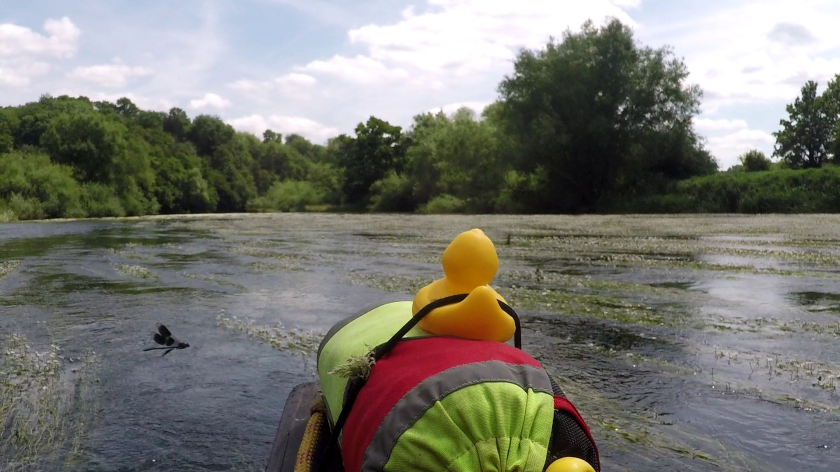
Banded Demoiselle and River Water Cowfoot
Banded Demoiselle and River Water Crowfoot

Overview

Continuing our trip down the Wye in stages this weekend we filled in one of the gaps- Bycross to Hereford. It is a pretty, rural and peaceful trip. It was 12.2 miles in all and took us 3.5 hours.

In July the water was quite low, so the trip down Monnington Falls was a mild grade two, with the passable channel very clear. Nonetheless, please note that it can be dangerous and warrants checking beforehand.

The journey

Points of interest (POI)Distance from start (miles)Distance from last POI (Miles)
Put in Bycross campsite
OS 148 SO373 435
00
Monnington Falls0.250.25
Byford1.91.65
Bridge Sollers3.21.3
Cannon Bridge5.42.2
New Weir5.80.4
Lower Eaton (Island)7.92.1
Lower Breinton (Church and NT)9.81.9
Hereford (Take out OS 148 SO396 509)12.22.4

Getting started

The Bycross campsite was busy! Although the orchard was busy with lots of hire canoes going out we didn’t see many travelling downstream. Quite a lot of people hire them for a ‘play’ without going far from the campsite. That tells you something about the flow just there…. We dropped the canoe near the ‘canoe slide’, and parked in the seasonal car park just 100 yards East of the canoe hire entrance. Check in the café – we were charged just £4 for launch and car parking.

Paddling on….

Monnington Falls comes up very soon. As a fairly new and nervous paddler I’d read about it online, looked in books and then asked the lovely man from Hereford Canoes what it was like on the day. In higher water, the river passes both sides of an island, but in the low water conditions that we saw this July the bedrock was dry on the right. There are lots of trees that grow into the channel (many have been cut back), but it was easy to see how they could create a serious difficulty and in higher conditions it would be important to check. We’d been at Symonds Yat the day before and this was an easier rapid, just a fun run down a bit of faster water, coming shortly to a wide pool. The ‘Wye Canoe’ publication has a good description and clear map of inspection points.

Part way through Monnington Falls

The trip calmed after this and we were reminded that large rivers can use quite a bit of paddling energy. Still, it was a great opportunity for me to learn (thank you Christopher, nothing like having your own personal canoe coach!) and practice my strokes. It’s hard when you need to re-learn or adjust how you do things, even if you know it will be more effective in the long run. Our three and a half hour trip gave me plenty of time to try and get it right.

After Monnington, the river meanders left into some weedy shallows coming up to Bridge Sollers (road bridge). In the Spring this just looks like flowing weed but in July we were treated to amazing blankets of delicate white flowers. The Wye is a JNCC Special Area of Conservation (see link below) and has some rare fauna and Flora including ‘River Water Crowfoot’ which grows in mats and, provides a sedimentary filter, a haven for invertebrates and fish and will modify the flow of water. Certainly the ducks that we saw sitting in lines on it, were eating heartily.

New Weir
Approaching New Weir (National Trust)

The beautiful river continues with well vegetated banks (Himalayan Balsam not in flower quite yet), but there were many other plants adding splashes of colour. At ‘Field’s Place’ (just one house) there are wooded banks and a small brook coming in from the right (we heard it rather than saw it!) There is no bridge at ‘Canon Bridge’, just some houses on the right.

There are plenty of places where it would be possible to rest for a picnic but a dearth of pubs and villages on this section of the river, so remember to take some food and a drink. The next notable point is the National Trust property at New Weir, (It’s OK, there isn’t a weir!) The gardens are high above the river, but the well-tended walled garden and walkway are easily seen. The manicured grass and varied trees add a completely different texture to the greens of our native deciduous trees. I could imagine that artists would make much of this wonderful variety in their paintings, but it’s not a talent that I have. The river meanders round to Sugwas from here and we are back to the local greenery.

There are houses on the right at Lower Eaton (Breinton) just before an Island that has a channel to the left, and a little further on is a Church and National Trust gardens at Lower Breinton.

It’s a longish paddle from here with minimal flow, but great if you want to lie out on a canoe and drift in gentle Summer sun (like the guy we saw just having a laze in the river). At this point the river gives up its meandering as though it suddenly thinks it needs to get to Hereford, so the bridges are visible from about 20 minutes away.

The first bridge is a pedestrian one just before you pass Hereford rowing club (left bank). Go under the road bridge and past the first set of steps and to a grassy bank on the right which goes up to the public park – hopefully right by the car park where your pick up vehicle awaits!

It’s quite a steep haul out, but not difficult if you have a longline.

Wildlife

The fauna and flora were wonderful, the only thing we thought we might see (but didn’t), was a swimming snake. (We saw one last year, but it was, apparently a rare sighting as both adders and grass snakes are in decline in the area).

There were lots of Mute swans, Canada geese, Mallards, Goosander, Dippers (flying low to the water then lining up on rocks), heron and…..not one, not two but THREE kingfishers. So excited to see them and actually all quite close to Hereford.

We saw HUGE salmon jumping, but the fishermen (to whom we gave loads of space) weren’t catching salmon though one reported catching a 5lb Barbel.

Also amazing were the dancing dragonflies, in particular the fabulous, dark blue ‘Banded Demoiselles’.

Links

Hereford Canoe and Kayak: Office  01981 257 258, Mobile 07747 837 554 paddle@herefordkayakcanoe.co.uk, http://www.herefordkayakcanoe.co.uk

Wye Canoe: https://www.gov.uk/government/publications/wye-canoe-canoeists-guide-to-the-river-wye

OS maps Landranger SO148

https://sac.jncc.gov.uk/site/UK0012642

http://wyevalleyaonb.org.uk/index.php/flora-and-fauna/reptiles/

https://www.rspb.org.uk/birds-and-wildlife/wildlife-guides/bird-a-z/dipper/

Hay-on-Wye to Bycross

Early in the Season, but very long trip down the Wye from Hay to Byecross.

Easter 2019

start point Hay on Wye
Start Point Hay-on-Wye

Overview

We’ve been paddling down the river Wye (and up it when I forgot the car keys too!!) in stages. This trip saw us start out near Hay -on-Wye and travel down to Byecross. Well, that was a bit of a journey… Safe to say we earned our dinner that day.

The journey

Points of interest (POI)Distance from start
(miles)
Distance from last POI
(Miles)
Put in Hay-on-Wye
OS 148 SO229 425
00
Clifford Castle2.452.45
B4350 Road bridge4.542.09
Island4.860.32
The Boat Inn,
Whitney-on-Wye
5.140.28
Turners Boat10.14.96
Road bridge
(and Red Lion pub,
Bredwardine)
3.63.51
Moccas Court15.92.31
Bycross17.31.4

Getting started

It’s always a bit of a car dance, especially when only one vehicle has a roof rack. We did a bit of an explore to start with and found the Bycross campsite. There was nobody about at the time, so we called Hereford canoes who have their base there. They were very helpful and put us in touch with the campsite owner so we established that we could leave one vehicle there. We then trekked back up to Hay-on-Wye and started our paddle just downriver of the bridge. Hay can be very busy and the one way system has its challenges but we passed the turn to the river bridge and took a left into a narrow lane and, hey presto, a small car park. This is a great place to launch and we were glad to get started.

Paddling on….

This was one of the prettiest Wye trips that we’ve done, it’s quiet and gets away from roads, taking long meanders though a variety of scenery. Clifford Castle is one of the first landmarks; a ruined Norman Motte and Bailey which stands in private grounds above the river (to the right). Rhydespence, just before the toll bridge marks the border between England and Wales. A little further on you can see the disused railway (and remains of an embankment)on t he left just before the B4350 crosess the river at a toll bridge. Watch for shallow water or obstructions at the island a little further on and just before the pub at Whitney on Wye, (left bank). We didn’t stop there but it looked possible to land a canoe and have a pint by the river. The Wye Valley Walk and Hereford Trail converge near the river (right bank) just after another good old loop in the river. Honestly, if you look at the OS map, it appears that someone just dropped a bit of wet blue string on the paper without taking the knots out. Still, the good bit about being in a canoe is that you are always just following your nose between two banks. Well, that is the plan!

Views from the river

We saw plenty of wildlife and some dramatic, lightning-struck trees.

Continue and pass the island known as Turner’s Boat on the left. There may be obstructions or shallows, so take care. The wooded hillside on the right is pretty and the river takes another meander away from here where you can see a small oxbow. If you’re a fan of music and traditional songs, you’ll know about he Australian song ‘Waltzing Matilda’ where the swagman goes down to the Billabong. This is Ozzie for oxbow.

Before too long you’ll come to Bredwardine – another Motte and Bailey, pub and more fabulous from a paddler’s low perspective is the six-arched bridge.

Playing at paddling
I think Christopher was missing his guitar!

We were getting pretty tired by now and wondering if we would actually recognise our take out point from the river (BIG note to selves, have a VERY good look next time!). Visions of ending up in Hereford were tempered by the thought that there would be taxis, pubs and roads, but it wouldn’t have been ideal. The meanders through farmland made for some interesting cuts in the river banks and sandy shores where the cattle came down to drink.

Again, lovely woodland on the left bank and a scar in the hillside at Brobury. Moccas Court on the left bank had superb parkland but was wrapped in polythene when we went by. If that is for refurbishment then there’s no doubt it’s a big project.

We did finally reach our take out at Byecross, recognised it easily (of course! Rationality just diminishes when you’re tired….) and didn’t quite get as far as Monnington Falls. That’s one for next time.

It was a very long day, (we reckon about 5 1/2 hours plus a short stop for lunch and a rest), but well worthwhile and if you aren’t so much into canoe marathons then there are plenty of places along the way to put in/take out. Most of the POIs I’ve mentioned will have one close by.

Wildlife

I’m not brilliant at identifying birds, but we have to start somewhere…. We had hoped to see Kingfishers (no such luck, unlike last Summer’s trip from Monmouth to Tintern when we saw Egrets as well as Kingfishers!). We did, however, see herons (and there is a story about those for another day…), Goosander (lots of them), mallards (of course, and I know what they look like!), Mute swans, Canada Geese, Mandarin ducks, Pochard and coots (very noisy).

Links

Hereford Canoe and Kayak: Office  01981 257 258, Mobile 07747 837 554 paddle@herefordkayakcanoe.co.uk, http://www.herefordkayakcanoe.co.uk

Wye Canoe: https://www.gov.uk/government/publications/wye-canoe-canoeists-guide-to-the-river-wye

OS maps Landranger SO148

Why go Paddling?

Being outdoors, the peace and quiet that allows us to see wildlife….who wouldn’t want to go out in a canoe?

Wye Valley 2019

I love being outside, and for most of my life I have been doing hectic sports -showjumping, eventing, skiing, 4×4 winch challenges, scuba diving, caving, cave-diving…… They all tick a box for me, real physical effort, technical challenge and being outside where I can appreciate the world around me. None of them has been easy, they all demand intense technical learning, the right motor skills and constant work to stay fit and sufficiently ahead of my game to stay safe.

Years ago I started kayaking to try and overcome my fear of water. I will never forget being the only one in the class who, when asked to swim two lengths of the swimming pool climbed down the steps instead of diving in confidently. OK, so it took me longer, and style was non-existent, but I swam my two lengths and the instructor then made me guinea-pig for the class and sat me in the B.A.T first. “Tip it over”, he said… I thought he was mad, I was more than terrified, but I did it and by the end of the session was pretty good at getting out of it… Who wouldn’t be?

The battle to overcome my fear of water continued when I met my husband and learned to dive. When I started I couldn’t even do a duck dive and to complete a ‘ditch and retrieve’ of kit in 4m (yes, it was no ordinary swimming pool where I learned, it was where the Special Boat Squadron train), took most of the Winter. But I did it and went on to become a ‘technical diver’, mix my own gases, dive deep and dive in caves.

I’ve learned that fear doesn’t go away, we simply learn to manage it and so even now I’m not confident in (or on!) water. You will see through my blogs that I will gradually find ways to deal with new mental and physical challenges that come with canoe touring. Now, for many of you, this might seem minor stuff, but we all have some thing which we believe could be our nemesis, though it probably won’t be.

So, why go paddling? What really drives me is the amazing perspective we can get from seeing Britain from the river, seeing our wildlife, experiencing the change of the seasons, the fabulous views and the people that we meet. I hope you will join me on my journey; we have some great plans for this year and have already made some trips (which you might like to read about).

Create your own website, free on WordPress.com.Create your own website.
Start free